Thursday, November 09, 2006

NYSE's Thain on competing for global capital: Why does everyone get this wrong?

The New York Stock Exchange's chairman John Thain spoke before the first annual conference of the Securities Industry and Financial Markets Association (SIFMA) in Boca Raton, Florida this week. (This is the first conference for the SIFMA because it only came into existance this year, as a merger of the Securities Industry Association and the Bond Markets Association.)

Jeremy Grant of the Financial Times writes about Thain's speech here. Unfortunately, neither the NYSE or the SIFMA have yet to publish Thain's remarks, so I'm not sure what he actually said (since I didn't attend the conference). But Grant's description of this speech, which includes the now-expected language about how Sarbanes-Oxley, state regulators, and class action lawsuits are pushing foreign companies away from U.S. capital markets, includes this:
[H]e said that the proliferation of lawsuits, Sarbanes-Oxley and overlapping regulations could stifle the country’s ability to compete for global capital. In a thinly veiled reference to London’s success in attracting company listings, Mr Thain acknowledged that US competitiveness was also threatened by exchanges around the world.

Most people, regardless of what they might think about this whole capital markets competitiveness debate (see here, here, here and here, if you want more), might just pass this off as typical speechifying. But it actually makes the same mistake that Stephen Bainbridge made a few weeks ago and which I wrote about here. That is, competing for public offerings and securities listings and competing for capital are not the same thing! Competing for capital means you are competing to attract investors -- i.e., the suppliers of capital. Competing for listings means you are competing to attract companies -- the users of capital. Of course, over the long-term, if you are good at attracting capital you will attract companies wanting to list on your market. But over the short- and medium-term, it's not at all clear that laws and regulations companies find onerous has any effect on your ability to attract capital (that is, investors). Indeed, you can easily imagine a situation where such laws actually attract investors, who become more confident in the integrity of your market. (Capital gains taxes, on the other hand, might actually hurt your ability to attract global capital.)

Why are these concepts so easily confused?

Big Audit Firms Release (Self) ''Serving Global Capital Markets and the Global Economy" Report

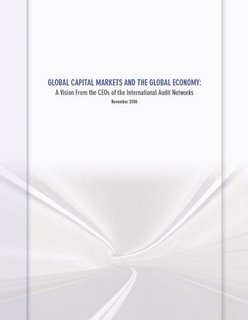
The CEOs of the Big Four accounting and auditing firms (PricewaterhouseCoopers, KPMG, Deloitte & Touche and Ernst & Young) and two smaller firms (Grant Thornton and BDO International) yesterday issued a report titled, "Serving Global Capital Markets and the Global Economy" (see link here.) The past few years have been simultaneously tough and extremely profitable for these firms, and this report represents a response to the industry's critics. Following age-old advice, these firms apparently believe the best defense is a good offense.

The bad part of the past few years has been obvious: Enron, WorldCom, Parmalat, Shell Oil and a host of other companies were all caught in accounting scandals. In each case, the independent auditors charged with confirming that public companies weren't cooking the books were all found asleep at the post--or worse. Arthur Andersen ceased to exist after the U.S. government brought criminal charges against it for destroying evidence related to the Enron scandal. Italian prosecutors indicted the local branches of both Grant Thornton and Deloitte & Touche as a result of the Parmalat fraud. And, in the United States, the Sarbanes-Oxley Act created a new regulator (the Public Company Accounting Oversight Board) to end the industry's self-regulation.

On the plus side, however, with this new oversight has come record profits. Auditing used to be a loss-leader accounting firms used as a foot-in-the-door to sell big companies much more lucrative management and IT consulting projects. Now, with passage of the Sarbanes-Oxley Act and the new focus on internal controls, auditing has suddenly become very profitable. Particularly since, with Arthur Andersen gone, there's one few firm to compete with.

It is the cost of these auditor fees that is now driving the PCAOB to revise U.S. audit standards. (See here.) Nonetheless, the audit industry is feeling unloved, and "Serving Global Capital Markets" is an attempt to influence the public debate on how U.S. securities regulation might best be reformed. (In this regard, the six auditors join a bandwagon that includes the "Paulson Committee" and the U.S. Chamber of Commerce.)

The report begins, as one might expect, by admitting to, and then downplaying, past failures. "In the late 1990s and earlier this decade, however, in a small, but highly publicized number of cases in the United States, Europe and Japan, certain members of our profession failed to meet the standards of quality that govern our profession." Yes, mistakes were made. But we're all past that now. The report goes on to note how important the audit industry is to the world economy, and how over-regulation of it and its clients might kill the goose that lays the golden eggs.

The report then makes several recommendations, four of which stand out:

  1. The world's accounting and auditing standards need to be harmonized and based on principles rather than rules; and audit industry regulation should be coordinated at the international level (rather than, as is currently the case, effectively dictated at the international level by the PCAOB);
  2. Securities regulations should change so that issuers no longer need to report quarterly financial statements (i.e., 10-Qs and 10-Ks in the United States), but instead should report financial and non-financial information to the public on a "real-time" basis, over the Internet;
  3. Laws governing the audit industry should change so that accounting firms are no longer prohibited from offering consulting and tax advice to their audit clients "in light of the capital markets’ clear interest in assuring the continued attractiveness of the profession and its ability to bring in and retain individuals with the requisite talent and skills"; and,
  4. Auditor liability should be capped in shareholder lawsuits so that audit firms don't go under should they make another Enron-esqe mistake. ("Audit firms and their global networks are not insurance companies. Legal and regulatory systems must reflect this reality. Individual auditors who engage in wrongdoing must be punished but without threatening the financial viability of their firms.")
The first point is a long-standing issue that, to date, has hinged mostly on accounting standards. The U.S. Financial Accounting Standards Board (which sets accounting standards for U.S. companies) and the International Accounting Standards Board (which sets accounting standards for many European companies) have been working together over the past several years to harmonize U.S. Generally Accepted Accounting Principles and International Financial Regulatory Standards. Everyone agrees, in theory, that a principles-based approach is superior to a rules-based approach, but reality has proven less than cooperative. A principles-based approach works only with strong, and fair, enforcement and oversight. Where shareholder lawsuits are a risk, however, rules trump principles -- you can prove to a court that you followed a rule. Demonstrating that you adequately adhered to a principle is more difficult and more open to second-guessing.

But more significantly, the report attempts to link the success of the U.S. GAAP-IFRS convergence project with the far more difficult effort to harmonized global auditing standards. Currently, International Standards on Auditing (ISAs) are a pale shadow of U.S. Generally Accepted Audit Standards (U.S. GAAS), and convergence is a long way off. (At the time of the Parmalat scandal, ISAs did not even require audit firms to confirm that a company's reported inventory existed. In other words, I could tell you that I have a warehouse in Hoboken with $3 million worth of product waiting to be sold, and you would not be remiss in your duties as an auditor if you just took my word for it.) For this reason, pushing for global harmonization of auditing standards -- and global "coordination" of auditor oversight -- could easily be seen as an attempt to weaken the iron grip of the PCAOB.

The second proposal is very interesting. But it is also pretty much a rehash of a proposal put forward by former SEC Chairman Harvey Pitt in 2001. Real-time disclosure of material information to investors would be a great boon, provided the quality and volume of information made available to the market increases, rather than decreases. At the same time, one can easily see how a real-time disclosure regime (particularly one enforced by a strong securities regulator) would be a God-send for accounting and law firms, which would pretty much have to become permanent fixtures in their clients' offices to ensure that the proper information was being disclosed. (The Financial Times has several articles on this proposal, here, here, and here. And given the way Barney Jopson writes, you might think the auditors' report is heralding the Second Coming.)

The third proposal, of course, is a desire to undo the conflicts of interest prohibitions contained in the Sarbanes-Oxley Act so that accounting firms can return to selling their audit clients very profitable management consulting work. However, it was the threat that they might lose such work that led to many of the financial scandals of the late 1990s through Enron and WorldCom. When a client holds out the promise of a multi-million dollar corporate restructuring consulting job, one can see how the pressure would mount on the audit partner to not upset the client with a harsh assessment of how it has accounted for its offshore "special purpose entities". Likewise, if an accounting firm has advised a client on how it should structure a corporate tax shelter, it's hard to imagine that same firm's auditors concluding that its colleagues over in the tax division screwed things up. The idea that accounting firms must be able to offer multiple services to the same client in order to attract bright young MBA and CPA employees properly deserves all the derision I can send its way.

And, finally, the issue of auditor liability is real, even if self-serving. (The New York Times' far more sceptical Floyd Norris writes about that aspect of the report here.) One problem world capital markets face today is that there are only four major international accounting firms left who are capable of offering a major multinational corporation a full multiple-country audit. (It is interesting that the heads of the Big Four pulled in the CEOs from Grant Thornton and BDO International for this report, since concentration in the audit industry is currently a topic of considerable discussion among securities regulators in North America, Europe and Asia. Representing the industry as a "Biggish Six" rather than a "Big Four" might be an attempt to stifle critics who argue audit industry concentration presents a risk to international financial stability and that governments should undertake to promote new rivals.) Consequently, in both the recent ChuoAoyama/PwC scandal in Japan and the KPMG tax evasion case in the United States, concerns were raised that a criminal indictment of either firm might pose a risk to the global financial system itself.

That said, "Serving Global Capital Markets" cannot help but be read as the audit industry's new campaign to limit its liability for future mistakes. The report cites an "expectation gap" regarding what they can do at a reasonable price, and what investors expect of them when it comes to detecting corporate fraud.

"...[T]he “expectations gap” arises because many investors, policy makers and the media believe that the auditor’s main function is to detect all fraud, and thus, where it materializes and auditors have failed to find it, the auditors are often presumed to be at fault. Given the inherent limitations of any outside party to discover the presence of fraud, the restrictions governing the methods auditors are allowed to use, and the cost constraints of the audit itself, this presumption is not aligned with the current auditing standards."

The problem with this view, of course, is that Enron, Parmalat and other corporate fraud cases were not simply matters of an auditor failing to detect an elaborate con perpetrated by evil masterminds. In the Parmalat case, it involved an auditor taking at face value an obviously forged letter purportedly from Citigroup attesting to the existance of an $800 million bank account. (The woman whose signature was forged actually did work for Citi, but apparently as a corporate librarian.) And, of course, while the report focuses on criminal penalties ("It is essential, going forward, for enforcement authorities to focus penalties for any auditor wrongdoing or negligence they may uncover on those directly implicated in such activities, rather than on the entire firms that employ them or with which they may be affiliated"), it is civil liability that is the crux of the matter. While auditors are not insurers against fraud, to argue that they cannot be held accountable for negligently overlooking fraud at the companies they audit is to suggest that their sole role is to check companies' financial statements for typos and math errors. Given that other participants in the global financial market (lawyers, investment banks, brokers, etc.) also face liability for negligence in the performance of their duties, why should auditors be different?

Tuesday, November 07, 2006

What’s wrong with the “NY-Lon debate”

I’ve been too grumpy to write recently because of a case of bubonic plague (or a nasty cold — can’t quite figure out which at the moment). However, an op-ed in the Financial Times today (“The NY-Lon Debate”) forced me away from my hot toddy long enough to get even more grumpy.

The FT notes a recent Wall Street Journal op-ed by New York City Mayor Michael Bloomberg (a Republican) and New York Senator Charles Schumer (a Democrat) (“To Save New York, Learn From London”). This op-ed demands changes to the Sarbanes-Oxley Act, U.S. shareholder litigation rights, and U.S. accounting standards (where did that come from??) in order to allow New York to fight back against the London onslaught on our financial markets.

Bloomberg’s opinion makes sense. To call Bloomberg “anti-regulation,” of course, would be a joke, given his nanny-state ideas about banning smoking, trans-fats and pretty much everything else he thinks is bad for you. But, as a former businessman and financier, you might expect him to be sensitive to anything that might impact the U.S. financial industry, if not the U.S. financial market (which isn’t at all the same thing).

For Schumer, on the other hand, the irony is just overwhelming. After all, Schumer was one of the foremost advocates of the strong version of the Sarbanes-Oxley Act, even adding his own provision banning corporations from making loans to their own executives. During SEC Chairman Christopher Cox's Senate confirmation hearings, Schumer also asked for (and received) assurances that Cox would not “roll-back” SOX. Best of all, of course, is that Schumer’s concerns about excessive regulation and litigation for some reason don't seem to include New York Attorney General Eliot Spitzer. Gee, I wonder why that is?

(The answer is because Schumer is an opportunistic hypocrite. Yeah, I know — big surprise.)

But back to the Financial Times op-ed. My favorite parts says:

...New York has now fallen behind London in raising capital for international companies. New York needs to overhaul its markets and its regulation but its verve as a city, its depth of human experience and its access to US capital mean that a fightback is guaranteed.

The question for New York is whether the damage is permanent. A 1963 tax law, which made it unattractive for foreign entities to borrow in New York, suggests that it may be. The 1963 law created London's Eurobond market but, on repeal in 1974, bond issuance stayed in Europe. Even if Sarbox disappeared tomorrow, New York might not win back business - such as Russian share issues - where London now has critical mass.

New York, though, should never be underestimated as a financial centre or as a city. It has great strengths. It is home to most of the world's top investment banks. It has the world's most efficient clearing and settlement infrastructure. And it can draw on the companies and investors of the world's largest economy.
My first question, as usual, is, what are these “international companies” we keep hearing about? For me, at least, an “international company” is a company with international operations. And if you are looking at that, New York is still by far the largest market for international companies. It’s just that most of the companies with international operations trading in New York happen to be headquartered in the United States. Notwithstanding the pain of Sarbanes-Oxley, no major U.S. public company has made London its primary listing.

Yet for London, “international” apparently means what we in the U.S. call “foreign.” So what about these foreign companies? While over the past year or so more non-British issuers have listed on the London Stock Exchange than non-U.S. issuers have listed in New York, foreign listings on the New York Stock Exchange still exceed those on the LSE. The difference, of course, is proportion — foreign listings are a relatively small proportion of total NYSE companies, while they make up a much larger proportion of the LSE.

And that gets me to my second question: why are foreign listings so important anyway? I’m not quite sure I’ve seen an answer to that, in either the Bloomberg/Schumer article or the FT op-ed. As the Financial Times notes, part of New York’s strength is that it can “draw on companies and investors from the world’s largest economy.” But isn’t that actually all of New York’s strength? Particularly the investors part? Right now, London is a world marketplace. And, as such, the City of London makes a profit off of the transactions that take place on that market. But the London Stock Exchange increasingly is a market for foreigners. It is not necessarily where British citizens put their money. The proportion of UK households invested in the UK capital market is approximately half the proportion of U.S. households invested in the U.S. capital market. For the U.S., then, a capital market is not just a place where financial firms turn a buck (or a pound) as middlemen, but a place where U.S. companies go to get low-cost capital and — more importantly — where U.S. investors go to get a high return on their dollars.

This point is underscored by several recent articles on the LSE’s Alternative Investment Market (AIM). An FT article last week by Sarah Spikes (“Evolution's profit warning highlights problem of dependency on Aim market”) notes that the poor performance of companies listing on the LSE’s low-cost/low-regulation exchange have put a serious dent in the profits of several investment banks. Indeed, over the past six months, as both the NYSE and NASDAQ have grown, shares listed on AIM have lost 20 percent. At the same time, many small and medium-sized UK enterprises are finding it far more costly to raise capital on the AIM than they expected. (See “Over-optimism causing UK mid-market failures”). Spikes’ first article quotes Andy Brough, a fund manager who specializes in small and mid-cap UK stocks for the UK investment firm Schroders as saying, “Surely the point of AIM should be to make money for investors, not just to make money for the stockbrokers that list companies on AIM.”

Indeed. Which brings up my final question. If the goal of a well-run capital market is to make money for investors and provide cheap capital to hungry companies, should it really be U.S. regulators’ concern if London now has a “critical mass” in certain areas — for example, Russian share issues? Given the corporate governance problems now plaguing Russian companies (see the Guardian’s Terry Macalister, “The Russians are coming — and bringing the threat of scandal to the City”), bragging about how your exchange is attracting the lion’s share of these questionable listings is a bit like a West Virginia trailer park bragging about how it is beating the pants off Martha’s Vineyard in the fast-growing mobile home market. It may be true, and it may be true that trailer park developers in West Virginia are making a ton of cash, while real estate developers in ritzier neighborhoods are getting hosed. But is it really the job of financial regulators to protect the profits of the “real estate developers” of the financial markets (i.e., the exchanges and market intermediaries)? Shouldn't the focus rather be on investors and issuers — no matter how many multi-billion dollar Rosneft or ICBC IPOs the market intermediaries lose out on?

Wednesday, November 01, 2006

John Kerry: Just shut up

I'm not a Don Imus fan, but he's right: John Kerry just needs to shut up. As I've said before, Kerry is still an idiot, and his comments to college students that if they don't study, they'll end up in Iraq just confirms it. Why the Democrats ever thought he was a suitable alternative to Bush still boggles my mind. What's amusing, though, is now many Democratics seems to be having those same thoughts. (See here.) What's also amusing is that the lesson Kerry seems to have drawn from the "Swift Boat Veterans" in 2004 is that any attack calls for an immediate and violent counterattack. I think this shows Kerry has a learning curve, in the sense that that is what he should have done (but didn't) in 2004. However, that this incident is a completely different kind of problem for him shows that the learning curve isn't too steep. Rapid nasty counterattacks are great if your opponent has made ridiculous and false accusations about you and you want to stop them from gaining traction; but if you are the one who stepped in the dog poop, they won't do.

In this sense, I think Kerry offers a good lesson for Democrats in what (not) to look for in 2008 presidential candidates. The first and most important lesson is to pick a candidate who actually won an election in a state with a large number of Republican voters. Massachusetts is not such a state. Fidel Castro, from his hospital bed, could run as a Democrat in Massachusetts and, if he were the only Democrat on the ballot, he would win. Bill Clinton, by contrast, came from a state (Arkansas) that goes either way. This has several advantages: first, it means the candidate knows how to appeal to a broader base and has the political skills to keep it from looking like obvious pandering. But perhaps more importantly, it means the candidate has enough touch with the broader electorate that that person automatically sees a red flag before saying something really stupid. If you are only used to Massachusetts voters, I can easily see how you might think Kerry's "botched" joke was funny. And, indeed, tell that joke to a bunch of Amherst students, and you'd probably get a lot of laughs. But you just come off looking like an idiot to the rest of the country.

Interestingly, what does this mean for Barack Obama? After all, he does come from a state with a sizable number of Republican voters. That said, he only won after his Republican rival self-destructed in a divorce scandal involving a beautiful cyborg ex-wife, and was replaced by an insane carpetbagger from Maryland. Does Obama have what it takes to take on a real opponent? Right now, nobody knows.

On the other hand, will Kerry's comments have an effect on the Republicans' chances of retaining the House next Tuesday? I kinda doubt it. Bush is still the face of the Republican Party, but Kerry is no longer the public face of the Democrats.

Tuesday, October 31, 2006

C'est le CNN contradictoire

The Agence Française de Presse is reporting that the international French news channel France 24 will start broadcasting worldwide in both English and French in an attempt to offer a "contradictory" view to those offered by the "Anglo-Saxon" CNN and the BBC. ("French news channel to challenge 'Anglo-Saxon' CNN, BBC").

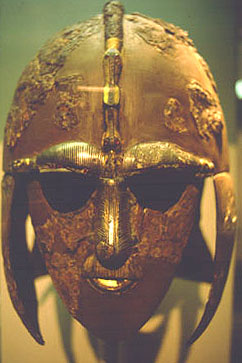
I love it when the French lump us and the Brits together as "Anglo-Saxons". It makes me want to grab my horned helmet and defend the great hall from Grendel the troll.

However, if anyone out there is qualified to offer contradictory opinions, it is the French. It just has to hurt that they feel forced to do this with an English broadcast.

Monday, October 30, 2006

Shareholder democracy in the U.S. brought to task

An interesting article by Kate Burgess and Andrew Grant in this past week's Financial Times ("Investors 'lack basic rights' on US boards") notes a peculiar feature of U.S. corporate governance and securities law. In particular, while the United States has been at the bleeding edge of securities law reform designed to strengthen corporate disclosure standards and come down hard on managerial malfeasance, the actual rights of shareholders of U.S. companies to "kick the bums out" (i.e., replace not just crooked but also poorly performing managers and board members) is surprisingly weak. This is even more so when the U.S. is compared with other Common Law countries such as the United Kingdom and Australia.

As Adolf Berle and Gardinar Means noted 70 years ago, the modern corporation is characterized by a "separation of ownership and control" -- in other words, the people who own the company (shareholders) do not actually run it. This is in stark contrast to most other models for organizing human economic behavior, such as partnerships, where the entrepreneurs who put in their money to create the organization actually have a close hand in running it (and face a significant personal risk should it fail). In fact, this single feature of the modern corporation is both its greatest strength and most dangerous weakness. The strength comes from the fact that modern corporations can draw on financing from millions of investors willing to accept a (comparatively) small risk for a small return, rather than the handful willing to take a major risk for a big potential return. But the weakness is that corporate managers are using "other people's money" when they run the company, and this poses an inherent conflict of interest.

This strength and weakness was recognized as long ago as 1776, when Adam Smith wrote in The Wealth of Nations:

This total exemption from trouble and from risk, beyond a limited sum, encourages many people to become adventurers in joint stock companies, who would, upon no account, hazard their fortunes in any copartnery. Such companies, therefore, commonly draw to themselves much greater stocks than any private copartnery can boast of. ...The directors of such companies, however, being the managers rather of other people's money than of their own, it cannot well be expected, that they should watch over it with the same anxioux vigilance with which the partners in a private copartnery frequently watch over their own. Like the stewards of a rich man, they are apt to consider attention to small matters as not for their master's honour, and very easily give themselves a dispensation from having it. Negligence and profusion therefore, must always prevail, more or less, in the management of the affairs of such a company.
Corporate governance and securities laws are two tools designed to reduce this problem. Corporate governance laws are meant to provide shareholders with mechanisms by which their own interests are protected against management, while securities laws are designed to give them accurate information about how the company is performing so they can make informed decisions. In the United States, corporate governance is mostly a function of state law and, in practice, of Delaware law in particular. And Delaware didn't become the home jurisdiction of 70 percent of U.S. public companies because of its particularly pro-shareholder approach. Quite the contrary. Delaware permits a number of anti-takeover devices, such as poison pills and staggered board member terms, designed to make it very difficult for shareholders to kick poorly performing managerial teams out of their coveted positions.

This issue recently became more prominent in the United States when the Second Circuit Court of Appeals ruled last year in AFSCME Pension Plan v. AIG, Inc. that the SEC's rule on proxy voting is unclear. When that decision came out, the SEC agreed to clarify the rule to state whether companies must include in proxy materials proposals to modify how board members are elected. However, the SEC recently backed off on when it will conduct this clarification, as apparently there is no consensus among the five Commissioners about how to do this.

This is a shame, as a recent letter to SEC Chairman Christopher Cox from 16 U.S. and international investors points out. As a large number of these investors are foreign (including the Association of British Insurers and the Third Swedish National Pensions Fund), they note in the letter that:
It cannot be emphasized enough how difficult it is for investors based outside the US to come to grips with the fact that shareholders of US companies lack basic rights which they take for granted in other developed markets. Both in principle and in practice, the American board election procedure is both outdated and detrimental to the maximization of long-term shareholder value.
Normally I would say that this sounds like typical UK whining. ("It cannot be emphasized enough..."? I mean, who says that?? And anyone complaining about the lack of shareholder rights in the U.S. clearly hasn't seen the system in France or Japan.) That said, they do have a point. Under the current system, the only control investors have over board performance is by "voting with their feet" -- divesting themselves of companies with underperforming boards or management. However, for large pension funds or index-based mutual funds, such divestments may not be practical or even permitted. At the same time, given how difficult hostile takeovers are in the United States, "normal" market mechanisms that might act to discipline a corporate board just aren't there, and the only real mechanism for a shareholder to assert his or her rights is through shareholder derivative litigation -- a costly, often self-defeating process.

As a practical matter, the institutional investors' letter may tie in closely to efforts underway by the so-called "Paulson Committee" (see here), though it seems likely that Hal Scott, Glenn Hubbard and John Thornton might not see it that way. Restraining tort lawyers may go a long way to improving the competitiveness of U.S. capital markets. However, such restraint will not be likely (or helpful) if other mechanisms for disciplining corporate boards and managers are not available. Therefore, improving shareholder proxy voting processes so shareholders are given back the right to appoint their own boards of directors, is important. It will make corporate managers more accountable for long-term performance, and better align the interests of those who control modern companies with those who own them.

Sunday, October 29, 2006

Prospective chair of House Finance Committee raises questions about global financial regulation

On a recent trip abroad, I was asked several times about the likelihood that the Sarbanes-Oxley Act would be repealed in the coming year, given Treasury Secretary Hank Paulson's stated desire to streamline U.S. financial regulation. (See here and here.) This is an understandable question. After all, if most of your U.S. news comes from the Wall Street Journal and Financial Times and you don't have a thorough understanding of the U.S. political system, you could see how someone might come to think that it is a matter of time before SOX gets pulled. However, as I've noted before, the Treasury Department in the United States is not as powerful as the finance ministries of most countries. Further, if the Democrats take control of the House of Representatives on November 7 (which seems more likely than not at this point), chances of a repeal of Sarbanes-Oxley drop considerably. Chances drop even more if, as expected, the SEC and PCAOB radically restructure how SOX Section 404 is implemented (see here).

This view was repeated this week by Representative Barney Frank (D-Mass.), who is clearly trying out for size the chairman's seat of the House Finance Committee. (As the senior Democrat on the committee, Frank is in line to become chairman should the Democrats gain a majority in the House.) In an interview with the Financial Times ("Top Democrat casts doubt on regulatory co-operation"), Frank stated that European concerns about the possible "export" of Sarbanes-Oxley were overblown, because "it's not going to happen" and "[s]ix months from now it will be less of a burden for companies than it is today. ...They [the SEC and Public Company Accounting Oversight Board] have the authority to thin out what is required. We think the accountants probably overloaded on the audit requirements."

However, Frank also cast doubt on the value of international regulatory cooperation:
"Joint action is theoretically [good] but what does that mean? In American baseball, if the runner and the ball arrive at the base at the same time, the tie goes to the fielder. Who breaks a tie if there is a disagreement over policy between the SEC and FSA?"
Frank then stated that he wasn't sure if a supra-national regulator was a good idea, but it might be something useful to look at in the future.

I'm not sure what to make of that statement, frankly. Frank certainly knows that the idea of a surpra-national financial regulator is a non-starter in the United States, unless, of course, the U.S. regulator were to be the international regulator. Even if the U.S. political environment changed so radically that international-level financial regulation were to become politically acceptable (and it certainly won't), current American laws make it illegal for U.S. securities and banking regulators to delegate any oversight or powers to an international organization. So, either Frank was talking without thinking (which wouldn't be the first time a politician has done that), or he was thinking of something else entirely. If he was thinking something else entirely, it is not at all clear what that might be.

Thursday, October 26, 2006

Restaurant Smoking Bans Redux

In a previous post ("Restaurant Smoking Bans"), M.D. Fatwa argued that smoking bans probably make sense, because there's very clearly a negative externality and a market failure. MDF suggests that the political popularity of smoking bans is evidence of a market failure. This is, to say the least, a deeply problematic statement. A proposal that would take $20 away from one person, burn half of them, and then split the rest among ten other people might be extremely politically popular -- over 90%! -- but the market's failure to provide this "service" is an argument in favor of markets and against government. But let's set this aside: it's not his main point.

Nor should we really concern ourselves with why, if MDF is right, hypersensitive nonsmokers don't constitute sufficiently large demand to create a market for nonsmoking restaurants. After all, MDF is a country boy living in the midwest, which as any good eastern elite like myself knows, is a vast wilderness where there are dragons and only a very small number of tiny villages with very few people. 10% of the population wouldn't be large enough to create a market for non-smoking restaurants -- that's, like, 1 person. In Chicago, maybe 2 or 3 -- totally not enough to support a restaurant. So we have to cut him some slack here.

The real problem with MDF's model of market failure is that ... he's not proposing a model of market failure. Market failure is when there exist costs or benefits that are not borne by the decision makers AND this alignment leads to over- or underproduction. It's kind of odd that MDF imagines the first requirement is being met -- apparently positionally sensitive nonsmokers are imagined to go to restaurants just as often and be willing to pay just as high a price when there is some smoking as when there's not. (If they went less, restaurants would get less profits, in which case they're internalizing the costs of their decision, right?) But okay, fine: let's suppose they don't go less and so there are external costs. But these external costs aren't translating into decreased restaurant attendance or food consumption (again, this is a necessary consequence of the stipulation that the costs of smoking borne by nonsmokers don't affect the restaurants' bottom lines). So where's the market failure? The market is producing the correct amount of output -- all we're talking about is the division of the value of the output.

The only way out is to say that positionally sensitive nonsmokers make their restaurant-attending decisions premised on the assumption that they will definitely not be affected by smoking, but then they get to the restaurant, sit next to the smoke, and think, "Crap! I forgot that there's such a thing as a smoking section! I really need to write that down -- or maybe we should just pass a law, because I can't be expected to remember stuff like that." Which is to say, they're irrational (which I suppose one could believe: I'm just not sure why, given that one believes some nonsmokers are irrational, one would also believe that those same nonsmokers should be allowed to make decisions about what kind of restaurant they're going to eat at ... or, much more importantly, what kind of restaurant I am going to eat at).

But leaving aside the possibility of irrationality, the only possibilities are that nonsmokers never decide to stop going to restaurants because of smoking, or that they do, but that the decrease in restaurant attendance by nonsmokers is more than made up by the increase in smoker attendance because smoking is allowed. Either way, there's no market failure.

Okay, so if there's no market failure, why are smoking bans so politically popular? Well, as MDF pointed out, 80% of the population doesn't smoke. So if all smokers vote against smoking bans and all nonsmokers vote for bans, how does that work out? Again, this doesn't mean there's a market failure -- elections don't count intensity of preference. (In other words, a vote of 2 yes's and 1 "no, oh no, please God, no!" still goes to the "yes" people.) So what we might have here is a plain old-fashioned story of rent-seeking: smoking bans might have higher costs than benefits, but why would a non-smoker care so long as the costs were borne by other people?

This might run into problems if voting for smoking bans will make even nonsmokers worse off (which it might very well). But who said people vote in a narrowly self-interested fashion? Some people who haven't been to a bar in years vote on whether we should ban smoking in bars -- how on earth could either outcome matter to them enough to justify going down to the voting booth? Well, it might matter if they also care if you are smoking in bars. So how's that one likely to break -- are there more people who (a) think that smoking is bad and therefore you should be kept from smoking (or kept from working around smoke), or (b) who think that it's none of their business whether you smoke or work in a bar? If you think (b), you need to get out more.

Finally, this could just be a matter of expressive voting. Look: unless your name is "Sandra Day O'Connor" or "Anthony Kennedy," your vote doesn't count. You will not ever break a tie. But you're not stupid and you know this -- so why would you vote as if the election turns on your decision? The answer is you probably don't. There are people in Texas who voted for Nader in 2000. Did they think Texas might not go to Bush? Of course not -- a lot of them would have voted for Gore if they thought their vote mattered. Given that your vote doesn't matter, you might just vote the way that makes you feel good. So, what, you want to be the kind of person who votes for blowing smoke in children's face? What about proposition "Let's not kick puppies?"

So, fine, let's ban smoking. But please let's not pretend that there's a market failure or that there's some sort of greater public interest story here. Nonsmokers have a majority and they can do what they want, or think they want, or like to tell other people that they want. End of story.

Tuesday, October 24, 2006

The face of a healthy democracy

You ever wonder why the U.S. Congress has a "sergeant-at-arms", or why the British Parliament has those yellow lines the MPs aren't supposed to cross?

This photo (from Rick Yi of Taiwan News) is Lee Ao, a Taiwanese parliamentarian. Apparently, the Taiwanese equivalent of a filibuster is to let loose a can of tear gas in the legislature. Hey, practical solutions for practical people.

Unfortunately for Lee, tear gas is notoriously ineffective against the superior lung capacity of most politicians. (You can see this from the picture; Lee himself doesn't actually need to use the gas mask he brought along.) Bug spray, on the other hand...

Monday, October 23, 2006

Restaurant Smoking Bans

Thomas A. Lambert, associate law professor at the University of Missouri School of Law, writes an op-ed in today's Washington Post against the proliferation across the country of restaurant smoking bans ("Against Restaurant Smoking Bans").

Lambert says:
Proponents of smoking bans contend that they address the "negative externality" smokers impose upon nonsmokers, shape individual preferences against smoking (thereby reducing the incidence of smoking), and alleviate the health risks associated with exposure to environmental tobacco smoke or "ETS." Considered closely, though, each of these arguments fails to justify the government-imposed restrictions.
He then argues that: (1) there are no widespread negative externalities (because if non-smokers or restaurant employees don't like smoky restaurants, they will go somewhere else, leaving the restaurant owner to take on the costs of the externalities); (2) the government has no business shaping individual preferences (and, besides, campaigns against smoking only make children want to smoke more as a symbol of rebellion against authority); and (3) the dangers of ETS are overblown.

I'll only look at Point 1 here. Point 2 is worth an entire debate. (Also, the point about childhood smoking is ridiculous, since it's not smoking per se that's the problem, but habitual smoking. It is clear that the proportion of the population that smokes regularly has decreased steadily over the years as smoking bans and Surgeons General warnings have come into play. To argue that smoking bans do not have an effect on habitual smoker preferences is to suggest that a smoker's demand for cigarettes is infinitely inelastic and they will smoke no matter how costly or inconvenient smoking becomes.) Finally, I think restaurant smoking bans revolve around Point 1 and not Point 3, at any rate.

My question is, if there are no negative externalities to restaurant smoking, then why have these bans proven so politically popular? I suggest that this fact alone demonstrates that there is some kind of market failure here. Non-smokers make up the vast majority of the U.S. population. According to the Centers for Disease Control, nearly 80 percent of the U.S. population does not smoke, up from only 57 percent in 1965. With this kind of discrepancy, you would think smoking in restaurants would be a non-issue. If non-smokers preferred non-smoking restaurants, the sheer weight of their numbers would make most restaurants non-smoking. On the other hand (and this is the interesting question), if non-smokers do not care about whether they share restaurants with smokers (and this might otherwise seem to be the case, since so few restaurants voluntarily become completely smoke-free), why are restaurant smoking bans so politically popular?

I suggest two possibilities: first, only a relatively small portion of non-smokers are hypersensitive to smoking in restaurants (and I don't mean "hypersensitive" in a negative way). This group is not large enough to have an economic impact on restaurants by themselves, but it is large enough to initiate a political ban. This hypothesis, however, begs the question why, if hypersensitive non-smokers are not numerous enough to have an economic effect on restaurants, why are they still numerous enough to defeat the political interests of smokers and restaurants, who presumably enjoy smoking in restaurants more (in aggregate terms) than hypersensitive non-smokers gain from a smoking ban.

My second suggestion is that in addition to this core group of hypersensitive non-smokers, there is a much larger group of "positionally sensitive" non-smokers who support such bans. "Positionally sensitive" (PS) non-smokers are willing to share a restaurant with smokers, provided the smokers are confined to a distinct part of the restaurant away from where they are (i.e., the "smoking section"). This situation is satisfactory perhaps 90 percent of the time. However, PS non-smokers run the risk (particularly during busy periods) of either having to sit directly adjacent to the smoking section or having to choose between taking a seat in the smoking section or having to wait for a table to open in the non-smoking section.

You can then see how this changes non-smoker political incentives, even if it does not change restaurant economic incentives. If 20 percent of the population wants to smoke in restaurants, but only 10 percent of the population is hypersensitive to smoking and won't frequent restaurants that allow smoking, most restaurants will allow smoking. If an additional 50 percent of the population are "positionally sensitive" non-smokers (with the remaining 20 percent of non-smokers having no preference whether they sit directly adjacent to a smoker during meals),* then most restaurants will have an economic incentive to have smoking and non-smoking sections. This seems to be the case now.

However, at any given time, 5 percent of the population (or one-tenth of PS non-smokers) are being inconvenienced by having to sit directly next to the smoking section or wait for a non-smoking table to open. This means that, at any given time, 15 percent of the general population is strongly in favor of a universal smoking ban. The size of this group is still not as large as the population that smokes, but the 5 percent of inconvenienced PS non-smokers is a rotating 5 percent. That means that, over the course of 10 restaurant visits, 65 percent of the population would support a universal ban.

The reason that this issue has shifted from the economic to the political realm, however, is lottery effect for positionally sensitive non-smokers. A 10 percent risk of being inconvenienced is not sufficent for PS non-smokers to stop frequenting a given restaurant. While they might otherwise forgo the benefit they receive from the restaurant if the risk of being inconvenienced was 100 percent, they are not willing to do this if the risk is only 10 percent. However, by supporting a legal ban on restaurant smoking, PS non-smokers can eliminate this 10 percent risk at little cost to themselves. (There is still some cost. A universal ban on restaurant smoking might present a slight risk to the viability of any given restaurant, and positionally sensitive non-smokers would suffer if their favorite restaurant went bankrupt.)

In other words, what restaurant smoking bans are really about is an attempt to force 20 percent of the population (smokers) to absorb the 10 percent risk they cause to 50 percent of the population (PS non-smokers) , plus the 100 percent risk they cause to 10 percent of the population (hypersensitive non-smokers). The market failure comes in because, even with these preferences, no individual restaurant can afford to ban smoking on its own, since only 15 percent of the population is ardently in favor of a smoking ban at any given time in his or her restaurant, versus 20 percent opposed. However, 65 percent of the population is harmed by this situation at one time or another.

Because of this, I suspect restaurant smoking bans will prove to have a negligible effect on restaurants. This situation has characteristics of an arms race. If any one restaurant adopts a ban, that restaurant loses out to the competition, since they can reliably expect to gain only 10 percent new customers versus a loss of 20 percent of existing customers. If all adopt a ban, however, none lose. (To argue otherwise is to suggest that smokers so enjoy smoking with dinner that they will stay home and cook themselves rather than go out. While possible, this seems unlikely. Smokers must forgo smoking in all sorts of places today, so they are likely used to having to wait a little to enjoy a smoke. Plus, how good is your own cooking likely to be if your sense of taste has been destroyed by tobacco smoke?)

Bars, on the other hand, may be a different story. It's unclear whether smoking makes people drink more (in which case bar owners have an incentive to allow smoking) or drinking makes people more inclined to smoke (in which case bars are currently being ripped off by the tobacco companies and should start demanding a cut).


*Other than the CDC figures, these percentages are fictional and merely used to demonstrate the idea.

Sunday, October 22, 2006

What's wrong with admitting arrogance and stupidity?

Frankly, I'm not quite sure why the U.S. State Department has jumped so quickly to refute Alberto Fernandez's interview with Al-Jazeera in which he apparently says the U.S. has shown a bit of "arrogance" and "stupidity" in some of its dealings with Iraq. (See "Envoy: U.S. Showed 'Stupidity' in Iraq".) In particular, State Department spokesman Sean McCormack, from Moscow, apparently has said "the quote as reported is not accurate."

I'm sure Fernandez deviated from the official script; and it's probably true that the translation may have missed some nuances. But, given the current situation in Iraq, there doesn't seem to be any harm in admitting to mistakes, even if you don't honestly believe there have been any. After all, the Iraqis are mad and believe there has been arrogance and stupidity, and U.S. troops on the ground (particularly those reservists and National Guard members held over on extended tours) certainly believe mistakes have been made. Further, Fernandez's comments don't say who was arrogant or stupid. (People can read into that all they want, but all that means is that they already have a firm opinion about who is stupid and arrogant. Renouncing Fernandez's comments is only going to reinforce their views.)

Friday, October 20, 2006

Kim Jong-Il tells Chinese "sorry" for nuclear tests

Hey, North Korea! Who's your daddy?!

Damn! Even if the Chinese envoy is exaggerating things, if the North Koreans don't immediately come out and denounce this, we'll know who's running the show in that neighborhood.

萬歲, 萬歲, 萬萬歲!

"How HP raped my privacy and Patricia Dunn sent me an e-mail apology"

I'll admit to blatant plagarism in the title of this post, but when you need to verbally kick somebody's ass, Mary-N-Texas is hard to beat. And when you read Pui-wing Tam's story in Thursday's Wall Street Journal ("A Reporter's Story:How H-P Kept Tabs On Me for a Year"), you'll realize that the Hewlett Packard folks, and their lawyers, need a serious ass kicking. (Unfortunately, you need a WSJ subscription to read the link.)

Ms. Tam is a WSJ reporter who covered HP until last year. As I've mentioned in previous posts (here, here, and here), HP undertook an investigation of its directors after someone on the board apparently leaked board strategy talks to reporters. This investigation crossed the line when the investigative firm used pretexting in order to obtain telephone and other records of the board members to see who they were talking to. This was bad enough. What we now know is that this investigative firm also used pretexting and internet viruses to obtain telephone, email and IM records from a number of reporters as well.

Now Tam reveals that HP's investors also engaged in dumpster diving, among other tawdry investigative techniques:
The trash study was carried out in January by Security Outsourcing Solutions Inc., a Needham, Mass., investigative firm that H-P employed, according to a briefing H-P officials gave me yesterday. Whether the sleuths ever encountered my toddler's dirty diapers, H-P said it doesn't know.

I learned this -- and more -- as I sat in a conference room at H-P's outside law firm yesterday in San Francisco, where attorney John Schultz ran through a litany of snooping tactics H-P's agents used against me as part of its effort to identify which of its directors might be leaking news to the press. For around a year, Mr. Schultz told me, H-P collected information about me. H-P's investigators tried at least five times, he said, to get access to my home-phone, cellphone and office-phone records. In several instances, they succeeded: H-P now has lists of calls I made to people such as my editors, my husband, my insurance company and a reporting source employed by one H-P rival.

H-P's agents had my photo and reviewed videotaped footage of me, said Mr. Schultz, of the law firm of Morgan, Lewis & Bockius. They conducted "surveillance" by looking for me at certain events to see if I would show up to meet an H-P director. (I didn't.) They also carried out "pre-trash inspections" at my suburban home early this year, Mr. Schultz said.
Mr. Schultz was carrying out a public promise by H-P Chief Executive Mark Hurd, who pledged before Congress last month that he would give investigation details to the targets of H-P's snooping. The company told me, in an email, that I would receive "a complete accounting of the information that H-P gathered about you and exactly what methods were used to collect it."

...

Many details of what H-P had done in my case I had already gleaned from some now-public investigation documents. According to those documents, H-P built up information on my husband, including where we got engaged and married. H-P sleuths reviewed voicemails I'd left for an H-P director, and got a description of my car. They read my instant messages to an H-P media-relations executive. According to the California attorney general, H-P's investigators also used the last four digits of my Social Security number to impersonate me in order to obtain my phone records, a technique known as "pretexting."

H-P's lawyer shed no new light on these details, but one thing's increasingly clear: H-P went to some truly strange lengths to dig up personal details.
The nature of the information that Tam knows was provided to the board makes it pretty clear that Patricia Dunn at least had reason to suspect that not all of these techniques were legitimate or legal.

At first, I thought the company had simply accessed a month's worth of my phone records. But I grew more concerned as the scope of H-P's tactics became clearer. I learned from documents released to Congress last month -- but not by Mr. Schultz yesterday -- that H-P's investigative team unearthed factoids about myself that I never knew. In one PowerPoint slide prepared for Ms. Dunn, H-P's team noted that I live precisely two miles away from former H-P director Mr. Keyworth. In another slide that mapped out -- like a spider's web -- Mr. Keyworth's relationships with the press and others, I learned that my real-estate agent, Mavis Delacroix, had once worked with his wife.
...

By July 2005, H-P had compiled background on many of its subjects, including me, according to documents released by Congress last month. In an investigation summary, H-P listed my educational background, the date I joined The Wall Street Journal, and information about my husband. The document also notes that I made 78 phone calls from my cellphone between April 16, 2005, and June 16, 2005. "An analysis of the subscribers of the 78 numbers is in progress," the document says.
That 2005 analysis, which H-P's lawyer wasn't able to provide me, probably yielded nothing more than a portrait of frenzied planning for my sisters' weddings. At the time, my family had just finished the wedding preparations for one of my sisters and we were busy organizing a bridal shower for my other sister. That meant frequent phone calls to and from my mother.

Still, H-P's investigative team compiled information on me. In November 2005, one of H-P's then directors turned over voicemail messages I'd left him earlier that year, according to an email from H-P's investigative team. That gave the company a record of my voice, which was stored away. Mr. Schultz, H-P's outside lawyer, told me yesterday that such records were collected to provide "context," in an attempt to link me to a source of the leaks.

H-P's probe ramped up again in January, after articles ran in The Wall Street Journal about H-P's talks to acquire technology outsourcing and consulting firm Computer Sciences Corp. and after an article appeared on CNET about a board of directors' retreat that same month. By late January, the second phase of the company's investigation -- known as Kona II -- was in full swing. (The investigations were dubbed Kona by Ms. Dunn, who named the probes after the location of her Hawaiian vacation home.)

That was when some of H-P's creepiest incursions on me occurred. On Jan. 30, Security Outsourcing Solutions reported that a "pre-trash inspection survey is in progress for the Tam residence," according to a document Mr. Schultz gave me yesterday. But there was more to the story: H-P investigation documents that Mr. Schultz didn't provide me reveal that in early February H-P's investigators also conducted "pre-surveillance reconnaissance" on directors and several journalists, including me.

...

H-P didn't just plan to infiltrate my neighborhood, however. According to the documents released by Congress, in one PowerPoint slide from February -- which was, again, missing from Mr. Schultz's briefing yesterday -- H-P investigators proposed sending in their team to pose as cleaning crew members or clerical staff in The Wall Street Journal's and CNET's San Francisco offices. Mr. Schultz said that as far as he knows, "that was never done."

By mid-February 2006, H-P had obtained my cellphone records for mid-December 2005 through mid-January 2006, Mr. Schultz told me. H-P's investigators later accessed my cellphone records for February and my home-phone records for January and February, he said.

H-P now had printouts of names and numbers of people I called. From these records, copies of which Mr. Schultz gave me, H-P discovered that of the 25 calls I made from my cellphone between mid-December and mid-January, I called home 20 times. In other records, H-P's investigators highlighted calls I made to current and former H-P executives, as well as calls I was making to my editors in San Francisco and New York. Twice, H-P saw that I called my insurance company. They saw that I often called my sister.

Among the calls H-P's investigators saw were those I made to sources for other stories I was reporting for the Journal -- including sources at H-P competitors. One call was to Marlene Somsak, a former H-P media-relations executive who now works at H-P competitor Palm Inc. H-P's phone records list Ms. Somsak's name and address. Ms. Somsak declined to comment. The list provided by Mr. Schultz also shows reporting calls I made to Lucasfilm Ltd. and the San Francisco Police Department. A spokeswoman for Lucasfilm declined to comment.

H-P's briefing of its spying on me is mum about other events around February 2006. Mr. Schultz had no information, for example, on how the H-P investigative team handed out a photo of me and a description of my car to their surveillance teams -- something that a congressional subcommittee has now made public. It's unclear where they got the information. H-P began researching my husband and whether he had any relationships with H-P directors and others -- work that was "90% complete" at the time, according to a note in a February document.

Also missing from Mr. Schultz's briefing was H-P's snooping on my instant messaging. In February, H-P's investigative team focused on my communications with one of their own media-relations executives, Mike Moeller, whom I frequently talked to as part of our jobs. That was when they accessed our instant messages, which generally included witty repartee such as the following transcript that H-P had in its files: Me: Nice results (for H-P's financial quarter). Mr. Moeller: Real nice. Nice guidance. Me: Yup.

Tam mentions HP's classy touch at the end:
Since then, H-P officials have apologized repeatedly for the investigations. Mr. Hurd apologized in a news conference and before Congress. Ms. Dunn emailed all nine journalists who were under scrutiny a similar apology. (In the copy she sent me, my name was written in a different font from the rest of the message.)
I find all of this mind-boggling. You don't need to be a lawyer to suspect that any investigative firm providing the information that Security Outsourcing Solutions Inc. was making Powerpoint slides of may have crossed into illegal territory. (Though maybe you do have to be a lawyer to imagine a scenario where collecting this kind of information on reporters wouldn't be considered illegal.) But it's the clear lack of judgment that gets me. It doesn't matter how much damage a leaky board member can cause a company -- it can' t possibly be as bad as having your chairman indicted, and a shadow cast on your CEO that he or she might be next.

And a word of wisdom to John Schultz and Morgan, Lewis & Bockius: unless you want to come off looking like Larry Sonsini and Wilson Sonsini Goodrich & Rosati, really really do your homework on this case, particularly before talking to victims who happen to work for very large newspapers.

Thursday, October 19, 2006

"Daily Fatwa" dies; "My Daily Fatwa" lives on

Here I was, thinking I was building a UK fan base with my incessant harping about the London Stock Exchange, and it turns out all you Brits out there are looking for news about the Daily Star's spoof "Daily Fatwa" newspaper! While I admit that "Page 3 Burka Babes" is a nice idea, it all seems a bit derivative, if you ask me. Particularly the title. Also, if you UK guys are looking for free speech protection for parodies and the like, you're living on the wrong continent, amigos. (However, I'll admit your recent high court decision extending protections against libel charges to reporters covering political figures is a step in the right direction--even if it's about seven decades late.)

All the same, it seems that the Daily Star ditched the idea after the newspaper's staff revolted against the idea. Frankly, there's your problem! If you are going to go down that route, especially in a heavily Muslim country, be prepared to go all the way. And, second, you're going to let a bunch of reporters push around your newspaper?? Unionized reporters?? Would Rupert Murdoch put up with that crap?

No wonder you lost your empire.

Japan assures U.S. that it doesn't plan on building nukes

I'm a bit confused. Given that North Korea has just detonated a nuke, and China isn't helping with the situation perhaps as much as it could (certainly not in the UN), and what China really doesn't want is a nuclear-armed Japan, why are we asking Japan for assurances that it won't develop its own nuclear arsenal? (See David Sanger's "Japan Assures Rice That It Has No Nuclear Intentions".)

Seems to me that that might be the kinda thing you just want to remain unsaid for the moment. Maybe a little strategic ambiguity? You know, maybe a little, "Oh, you know, I forgot to ask... What do you think, Mr. Zhu?"

Wednesday, October 18, 2006

"Paulson Committee" may soon take on the trial lawyers by proposing limit on shareholder lawsuits

Securities Litigation Watch is reporting that the Committee on Capital Markets Regulation may recommend by next month that the SEC undertake certain policies that will reduce the abilities of shareholders to file certain types of class action lawsuits against public companies. This is an interesting shift from the Committee's original implied purpose of lobbying for repeal of the Sarbanes-Oxley Act. It also may represent a shift in focus to better reflect political and regulatory realities. (The Committee apparently is now called the "Paulson Committee" because it will give its report to Treasury Secretary Hank Paulson; but also because, as I discuss here, Hank Paulson himself has a keen interest in "reforming" U.S. financial regulation and has signaled support for the group.)

The Sarbanes-Oxley Act has provoked intense criticism among many public companies (including many foreign companies) because of the costs the Act imposes. However, as I have discussed more in-depth here, the principle costs of the Act involve Section 404, which requires a company's auditors to opine on the company's own assessment of its internal controls. By this December, the Public Company Accounting Oversight Board, which oversees the U.S. audit industry, likely will change the audit standard governing this process (see here).

Yet SOX is hardly the only cost the U.S. system imposes on public companies--nor even the most significant. If you are an issuer, your biggest concern is and long has been private lawsuits. As one securities law partner once told me, when you have an IPO in the United States, it's not a question of whether you will be sued, but when. If a company's stock drops significantly, "strike suit" attorneys have a strong incentive to file a class action lawsuit against the company, because the law firm's take from such suits ranges up to a third of the settlement (and once a judge certifies a class in a shareholder suit, most companies settle).

Of course, many shareholder rights to file private lawsuits are contained directly within the federal securities laws. For example, if a company's prospectus contains wrong information about the company's financial performance (other than inconsequential typos and the like), shareholders have a right to sue the company under the Securities Act of 1933. However, the Paulson Committee is focusing in particular on the SEC's Rule 10b-5. This Rule, which is a jewel of regulatory drafting, states simply:

It shall be unlawful for any person, directly or indirectly, by the use of any means or instrumentality of interstate commerce, or of the mails or of any facility of any national securities exchange,

a. To employ any device, scheme, or artifice to defraud,

b. To make any untrue statement of a material fact or to omit to state a material fact necessary in order to make the statements made, in the light of the circumstances under which they were made, not misleading, or

c. To engage in any act, practice, or course of business which operates or would operate as a fraud or deceit upon any person,

in connection with the purchase or sale of any security.


Isn't that beautiful? Personally, I think it ranks right up there with "Thou shalt not steal" in terms of simplicity and universality. Pretty much anything naughty you can think up involving the stock market or a public company could fall under it.

What the Committee apparently would like to do, however, is have the SEC "dis-imply" that this Rule allows for a private right of action from shareholders. In other words, right now the rule "implies" that individual shareholders can sue a company or individual for a 10b-5 violation, even if the SEC doesn't. If the SEC stated that Rule 10b-5 belongs to it alone, the SEC could sue someone for violating Rule 10b-5, but the courts could say an individual shareholder couldn't. And an investor certainly couldn't if the SEC hadn't also brought a case. Since 10b-5 is so broad, that would mean that "defrauded" shareholders would have to find some other cause of action to sue. Depending on the case, this may not be hard; but it won't necessarily be easy, either.

This proposal (which apparently comes from Columbia Law professor Jack Coffee) is smart--much smarter than proposals to throw out Sarbanes-Oxley. For one thing, SEC Chairman Christopher Cox is well-known for his belief that strike suits should be dramatically scaled back. When he was in Congress, he was the principle author of the 1995 Private Securities Litigation Reform Act, which was designed to do precisely this. Second, it addresses a factor about the U.S. capital market that actually does make it less competitive internationally. (Though one may argue that the private right of action contained within U.S. securities laws acts as a much better policeman of U.S. securities markets than the SEC, Justice Department and Eliot Spitzer combined ever could.)

That said, the trial attorneys are a formidable opponent, and we can expect that they will lobby the SEC (and Congress) hard to make sure this proposal is never made a reality.

Tuesday, October 17, 2006

California ballot initiatives: The stupidest thing I've seen today

Trust me. I see a lot of stupid things on a daily basis. But California's Proposition 87 on alternative energy is the stupidest I've seen today. You can read a summary on the California State website here, if you don't want to read the longer link above.

There are so many stupid things about this bill that it's hard to know where to begin with my Fatwa. But let's look at two of the most glaring:
  1. A $4 billion fund for research is created by imposing a 1.5% to 6% tax on California-produced oil. Not on oil generally. Not on gasoline. Just California-produced oil. Since this means that California oil will cost 1.5-6% more, and California is not a major oil-producing place, how is this going to reduce U.S. dependence on foreign oil? For that matter, how is it going to raise $4 billion?
  2. The proposal "prohibits producers from passing the tax on to consumers." How exactly does that work? Where's the money coming from? From the companies themselves? If so, why would they produce oil in California when there are other more profitable places to do it? And if they don't produce as much (because it's not as profitable anymore), doesn't that mean the supply will decrease and the price will go up? How do you prohibit that?

The problem here is a massive failure of the public education system. If you want to tax something, you have to ask where that tax is coming from. And when you say its coming from "the corporations," I want you to show me one of these corporations. Fair warning, though: If you point at a building with a company's name on it, I will smack you with a 2-by-4 and put a fatwa on your ass! That's a building with a corporation's name on it, not a corporation. I want you to show me a corporation!

OK, trick question. Because there's no such thing! A corporation is a legal fiction, idiots! It's just a bunch of people! Some of those people are rich; some are poor. Most are paid a salary; some get paid dividends. In California, a lot of the people getting paid dividends are members of the California Public Employees Retirement System. If you want to take people's pension money, why don't you just do that, instead of screwing around with moronic propositions that will just get some schmuck laid-off or relocated to Oklahoma?

Why must stupid people plague me so? Why? What did I do to them?

Congress giveth and Congress taketh away (Part 2): The Financial Services Regulatory Relief Act

As mentioned in my previous post here, two laws recently have been passed by Congress and signed by President Bush that will have a big impact on the regulation of U.S. financial markets. Neither of these laws have received much press, and I suspect that most Congressmen didn't even know what they were voting on when they agreed to them. They don't directly touch on issuers or investors, so, unlike Sarbanes-Oxley, they are pretty much under the radar screen. But they both will have a profound impact on what the Securities and Exchange Commission's Division of Market Regulation does.

The first of these laws is the Credit Rating Agency Reform Act. As I discussed, this new law has plopped into the SEC's Division of Market Regulation broad new powers to regulated some of the most powerful financial firms in the world--credit rating agencies such as Moody's Investor Services and Standard & Poor's. The second new law does the opposite--the Financial Services Regulatory Relief Act takes away a good dollop of the SEC's powers over banks that offer both retail banking and brokerage services (which are most brokerage houses these days). Section 101 contains the really juicy part:


SEC. 101. JOINT RULEMAKING REQUIRED FOR REVISED DEFINITION OF BROKER IN THE SECURITIES EXCHANGE ACT OF 1934.
(a) FINAL RULES REQUIRED.

(1) AMENDMENT TO SECURITIES EXCHANGE ACT. Section 3(a)(4) of the Securities Exchange Act of 1934 (15 U.S.C. 78c(a)(4)) is amended by adding at the end the following:

(F) JOINT RULEMAKING REQUIRED. The Commission and the Board of Governors of the Federal Reserve System shall jointly adopt a single set of rules or regulations to implement the exceptions in subparagraph (B)..
(2) TIMING. Not later than 180 days after the date of the enactment of this Act, the Securities and Exchange Commission (in this section referred to as the "Commission") and the Board of Governors of the Federal Reserve System (hereafter in this section referred to as the "Board") shall jointly issue a proposed single set of rules or regulations to define the term "broker" in accordance with section 3(a)(4) of the Securities Exchange Act of 1934, as amended by this subsection.
...

"Damn!" I can hear you saying. "Nobody told me law stuff was going to be on the exam!" Don't worry, it just means that the SEC has to coordinate with the Federal Reserve when issuing rules and regulations regarding stock brokers. As Jim Hamilton explains here, "The measure is intended to ensure that regulators do not create a new and burdensome maze of requirements that would disrupt or interfere with the business practices of banks and thrifts that offer traditional bank products and services." As Hamilton also explains, this bill has been in the works for several years, as had promises by the SEC to coordinate its brokerage rules with banking regulators. Now, with this new law, it will have 180 days to do so. (You can also check out the SEC's press release on the matter here.)

Cutting through all the legal language and political niceties, what this means is that the SEC will have to coordinate its rules on brokers with the Federal Reserve. And, as all of us know, the Federal Reserve gets to wear the pants in that relationship. (This is the hierarchy in U.S. financial regulation: When the Fed and the SEC are involved, the Fed is butch. Basically, when the Fed is involved with anybody, it gets to be butch. When the SEC and the Commodity Futures Trading Commission are involved, the SEC is the dominant player. When the SEC and the Treasury Department are involved, the SEC stalls until the next election. When any federal financial regulator other than the Fed is involved with a State Attorney General, the federal regulator will get this deer-in-the-headlights look and start arresting or suing everybody in sight.)

There are several reasons for this change (other, that is, than the stated reason Hamilton notes--to cut down on conflicting cross-functional regulation.) The Gramm-Leach-Bliley Act broke down the barriers between retail and investment banking, and since then, every local bank has opened a brokerage arm to sell securities to its customers. (You've probably gotten these brochures yourself when you opened a bank account and were offered "investor services" as well.) All of these local banks are much more comfortable dealing with the Federal Reserve than the SEC. And, let's be honest--so is pretty much everybody else. It's been said that the Federal Reserve is like the Good Samaritan who nurses your wounds after you've been mugged, but lets the mugger escape; the SEC, on the other hand, has been described as the cop who ignores you as you lie bleeding on the floor and instead chases down the mugger and beats him to a pulp. If you are a potential mugger (and, since we're being honest here, most brokers are), who would you prefer to be regulated by?

So the SEC's Division of Market Regulation is very concerned right now that the Financial Services Regulatory Relief Act of 2006 has made them irrelevant. The ironic part about this, of course, is that it is not the Division of Market Regulation that has made the SEC so feared and loathed among bankers-cum-brokers. (That honor goes to the SEC's Office of Compliance, Inspections and Examinations.) If the SEC behaves like a bureaucracy (and I'm guessing it will), this will mean that we can expect the Division of Market Regulation to do everything it can to hang on to whatever power it has left. And this may not be a good thing, if it gets in the way of other reforms designed to improve the competitiveness of the U.S. capital market.

Friday, October 13, 2006

New form of Extreme Fighting becomes popular with today's youth: Frozen-shrimp-in-the-pants Wrasslin'

The York, Pennsylvania Daily Record reports that Kenneth George Bilwin II, 28, ("of no fixed address") managed to take on two Giant grocery store managers while packing three bags of frozen shrimp in his pants. He was only subdued and taken into custody after two of the power-packing bags of shrimp fell out of his baggy pants.

In my opinion, Bilwin deserves his fate. Everyone knows that the power three bags of frozen shrimp in your pants can give you will be lost if two of those bags fall out. And, trust me, you will need that power if you are going up against two Giant grocery store managers. That's why I always wear contour-hugging tighty-whities (and nothing else) when stuffing bags of shrimp down my pants.

(Thanks again to Pokey for the tip.)

Single-payer health plans, French-style

The Agence France-Presse is reporting that between May 2004 and May 2005, a new software program at Epinal Hospital in Lorraine led to patients being exposed to excessive doses of X-rays in prostate cancer scans, leading to the death of one man. (See "One dead, 13 injured in X-ray blunder at French hospital".) 13 others became so ill that they have had to be fitted with artificial anuses.

Ouch. Don't get me wrong. I'm all in favor of cyborgs. But a bionic butthole wouldn't be my first choice of replacement parts.

(Many thanks to Pokey for the tip.)