Andrew Bounds of the Financial Times writes today in "Green laws ‘may harm Europe’s economy’" that Günter Verheugen, the EU's industry commissioner, is warning that “We have to recognise that ... our environmental leadership could significantly undermine the international competitiveness of part of Europe’s energy-intensive industries and worsen global environmental performance by redirecting production to parts of the world with lower environmental standards.”
I'm shocked! Shocked!! And here all this time I thought these new green technologies were going to give the European Union a competitive advantage versus the rest of the world when demand for these technologies skyrockets.
Well, at least all is not lost. I've invested the other half of my money in developing baseball fields in the middle of Iowa corn farms. Because, you know, if you build it, they will come and buy it.
Friday, November 24, 2006


Tuesday, November 21, 2006
Well, at least he gave me an "A" once
Truth be told, I was not a very good law student. First, I hate lawyers. That's always a strike against you in law school. Second, I hate legal precedent. I mean, why should I reference some idiot's clearly bad decision 20 years ago just because he or she happens to have gotten appointed to the Supreme Court?
Be that as it may, I did do well in a few classes. Cass Sunstein's was one of them, and I always wondered why given that I rarely agree with him on much. (Plus, there was that time I accidentally implied his life resembled a country/western song. Hey, how was I to know his dog had just died??)
However, I'm starting to figure it out. I may not agree with Sunstein on much, but apparently he agrees with me! In a recent article by Sunstein & Bo Cowgill in The New Republic ("Can predictions markets forecast elections? Good Bet") , Sunstein and Cowgill argue that, even though online prediction markets (such as Tradesports.com) failed to predict the Nov. 7 Senate elections (as I noted here), they are still better at making predictions than pretty much anything else. Sunstein and Cowgill also rightly find the lack of faith of Reason Magazine's Katherine Mangu-Ward, the DailyKos' Markos Moulitsas, and Atrios disturbing.
That said, as Sunstein and Cowgill allude, the really interesting question is where and why prediction markets will consistently provide wrong answers. (And to think they won't is to have too much faith.) Some markets will have too few bettors and too little information. Those are easy. But are their other types of events that will consistently stymie prediction markets, for less obvious reasons? If you can figure out what those events are, you can make a lot of money. But then, of course, the prediction markets would be working, wouldn't they?
Be that as it may, I did do well in a few classes. Cass Sunstein's was one of them, and I always wondered why given that I rarely agree with him on much. (Plus, there was that time I accidentally implied his life resembled a country/western song. Hey, how was I to know his dog had just died??)
However, I'm starting to figure it out. I may not agree with Sunstein on much, but apparently he agrees with me! In a recent article by Sunstein & Bo Cowgill in The New Republic ("Can predictions markets forecast elections? Good Bet") , Sunstein and Cowgill argue that, even though online prediction markets (such as Tradesports.com) failed to predict the Nov. 7 Senate elections (as I noted here), they are still better at making predictions than pretty much anything else. Sunstein and Cowgill also rightly find the lack of faith of Reason Magazine's Katherine Mangu-Ward, the DailyKos' Markos Moulitsas, and Atrios disturbing.
That said, as Sunstein and Cowgill allude, the really interesting question is where and why prediction markets will consistently provide wrong answers. (And to think they won't is to have too much faith.) Some markets will have too few bettors and too little information. Those are easy. But are their other types of events that will consistently stymie prediction markets, for less obvious reasons? If you can figure out what those events are, you can make a lot of money. But then, of course, the prediction markets would be working, wouldn't they?
U.S. Treasury Secretary jumps in front of parade and starts waving baton
Treasury Secretary Hank Paulson gave his long-awaited capital markets speech in New York yesterday. A copy of the speech can be read on the Treasury Department's website here. Little of what the speech discusses is new, of course. In fact, much of it has been debated in detail for nearly a decade (principles versus rules-based regulation, accounting convergence, costs versus benefits of regulation, etc.) However, given how many new proposals are in the pipe to reform post-Sarbanes-Oxley capital markets regulation (including SEC and PCAOB proposals to reform how Section 404 is implemented -- see here and here), I get the feeling that Paulson is preparing to take credit for reforms that have been in the works for quite some time.
Paulson's discussion of foreign market development, though, is worth a read. As he notes (and as I noted in this post previously), part of the shift away from New York's dominance of the IPO market comes from the growth of other non-US (and non-European) markets with high regulatory standards. This shouldn't be a surprise; if the US was getting something right in the 1990s, it's only natural that other countries would try to figure out what that was and do it themselves . This is even more the case when the United States, as a member of international groups such as the International Organization of Securities Commissions (IOSCO), goes around preaching exactly what it is that makes a capital market work well.
Nonetheless, Paulson's reference to the principles-based International Financial Reporting Standards (IFRS) as being better that US accounting standards strikes me as a little odd. Not that I disagree with this. However, as Manuel Conthe, the chairman of the Spanish securities regulator noted at last week's IOSCO Conference in London, issuers can't simultaneously demand principles-based regulation and then be upset when regulators interpret those principles in ways different than they do. That's the thing about principles: they leave a lot open to interpretation and, at least in the United States, do you really want a judge to second-guess how you've interpreted and applied an accounting principle? (Because, trust me, they will.) Arthurs Docters Van Leeuwen, the chairman of the Netherlands Authority for Financial Markets and chair of the Committee of European Securities Regulators (CESR), at the same conference also noted that, given principles avail themselves of a wide degree of interpretation, global market participants should be aware of the inherent conflict between principles and a level international playing field -- "You can have principles or you can have a level playing field, but you can't have both."
Too bad Paulson didn't attend the conference.
Paulson's discussion of foreign market development, though, is worth a read. As he notes (and as I noted in this post previously), part of the shift away from New York's dominance of the IPO market comes from the growth of other non-US (and non-European) markets with high regulatory standards. This shouldn't be a surprise; if the US was getting something right in the 1990s, it's only natural that other countries would try to figure out what that was and do it themselves . This is even more the case when the United States, as a member of international groups such as the International Organization of Securities Commissions (IOSCO), goes around preaching exactly what it is that makes a capital market work well.
Nonetheless, Paulson's reference to the principles-based International Financial Reporting Standards (IFRS) as being better that US accounting standards strikes me as a little odd. Not that I disagree with this. However, as Manuel Conthe, the chairman of the Spanish securities regulator noted at last week's IOSCO Conference in London, issuers can't simultaneously demand principles-based regulation and then be upset when regulators interpret those principles in ways different than they do. That's the thing about principles: they leave a lot open to interpretation and, at least in the United States, do you really want a judge to second-guess how you've interpreted and applied an accounting principle? (Because, trust me, they will.) Arthurs Docters Van Leeuwen, the chairman of the Netherlands Authority for Financial Markets and chair of the Committee of European Securities Regulators (CESR), at the same conference also noted that, given principles avail themselves of a wide degree of interpretation, global market participants should be aware of the inherent conflict between principles and a level international playing field -- "You can have principles or you can have a level playing field, but you can't have both."
Too bad Paulson didn't attend the conference.
Does anyone know what Michael Kinsley is talking about?
Holy context-less arguments, Batman! But I swear, I can't really make out what Kinsley is trying to say in his most recent Washington Post op-ed ("A Capitalist Swindle"). Is he talking about squeeze-outs in a hostile takeover? Either Kinsley's article has been edited down to the point where critical elements of his argument have been deleted (wouldn't be the first time an editor has done something stupid like that); or Kinsley doesn't understand the topic well enough to describe what he is upset about.
Any ideas out there?
Any ideas out there?
Friday, November 17, 2006
If you think the US legal system is screwed up...
This past weekend the London Times reported that the United Kingdom's Home Office (which is something of a combination of the US Departments of Justice and Homeland Security) agreed to pay 198 heroin-addicted convicts £5,000 each (about $9000) because the UK Prisons Service forced them to go "cold-turkey" in prison. The prisoners sued the British government for trespass, arguing that they had not consented to the "treatment" of being deprived of the drug. They also sued for breaches of the European Convention on Human Rights, which prohibits discrimination, torture or inhuman or degrading treatment or punishment.
The Home Office agreed to the £1 million payout after agency lawyers warned that the government was likely to lose the lawsuits.
See "Inmates win 'cold turkey' payouts".
The Home Office agreed to the £1 million payout after agency lawyers warned that the government was likely to lose the lawsuits.
See "Inmates win 'cold turkey' payouts".
Thursday, November 16, 2006
SEC Chair Chris Cox and MP Ed Balls trade shots in London
Rather than the FSA's Callum McCarthy carrying London's water (as I predicted here), Member of Parliament and Economics Secretary Ed Balls (of the famous "Balls Clause") spoke as first keynote at the IOSCO Technical Committee conference in London today. Balls stated that there is a need throughout the world for a "risk-based, proportional regulation" and for others to "respect the rights of each nation to regulate its own financial services industry and the financial markets that operate in its territory as it thinks best." (Take that, America!)
Towards this end, Balls announced he was proposing today a bill in Parliament (discussed earlier here) called the "Investment Exchange and Clearing House Bill" that would give the FSA a veto power over future rules and operations that apply to UK exchanges and clearing houses, if those new rules were not "risk-based or proportional." Because, you know, industry is always imposing harsh and disproportionate regulations on itself.
The bulk of Balls' talk focused on hedge funds. Hedge fund regulation is important to the City of London because, while 70 percent of the hedge fund market is in the United States, quite a few of the funds marketing to U.S. clients are actually in the UK. Consequently, when the SEC talks about regulating hedge funds in the United States, London hears "extraterritoriality".
Yet, despite Balls' focus on hedge funds, the decision by the Deutsche Borse to rescind its offer for Euronext was a specter in the room, as was the decision by several major investment banks to form their own trading platform to avoid the high costs of conducting trades on the London Stock Exchange. This combination has put new pressure on the LSE, as it effectively now faces two new competitors -- an NYSE-Euronext merger and a new electronic trading platform being put together by its biggest customers. Unsurprisingly, shares in the LSE dropped 5.7 percent yesterday, while Deutsche Borse shares dropped 4.6 percent.
A copy of Balls' speech can be found here.
SEC Chairman Christopher Cox followed Balls with a second keynote address where he quoted Max Weber, Louis Brandeis and even French radical Jean Jacques Rousseau in warning against the "temptation for regulators to relax their standards to attract investors and issuers, at the expense of the other jurisdictions -- with the result that the overall standard of regulatory quality suffers." Cox also announced that the SEC would be introducing management guidance, to supplement new audit standards from the PCAOB, designed to radically reduce the costs to U.S. issuers of implementing Section 404 of the Sarbanes-Oxley Act.
Towards this end, Balls announced he was proposing today a bill in Parliament (discussed earlier here) called the "Investment Exchange and Clearing House Bill" that would give the FSA a veto power over future rules and operations that apply to UK exchanges and clearing houses, if those new rules were not "risk-based or proportional." Because, you know, industry is always imposing harsh and disproportionate regulations on itself.
The bulk of Balls' talk focused on hedge funds. Hedge fund regulation is important to the City of London because, while 70 percent of the hedge fund market is in the United States, quite a few of the funds marketing to U.S. clients are actually in the UK. Consequently, when the SEC talks about regulating hedge funds in the United States, London hears "extraterritoriality".
Yet, despite Balls' focus on hedge funds, the decision by the Deutsche Borse to rescind its offer for Euronext was a specter in the room, as was the decision by several major investment banks to form their own trading platform to avoid the high costs of conducting trades on the London Stock Exchange. This combination has put new pressure on the LSE, as it effectively now faces two new competitors -- an NYSE-Euronext merger and a new electronic trading platform being put together by its biggest customers. Unsurprisingly, shares in the LSE dropped 5.7 percent yesterday, while Deutsche Borse shares dropped 4.6 percent.
A copy of Balls' speech can be found here.
SEC Chairman Christopher Cox followed Balls with a second keynote address where he quoted Max Weber, Louis Brandeis and even French radical Jean Jacques Rousseau in warning against the "temptation for regulators to relax their standards to attract investors and issuers, at the expense of the other jurisdictions -- with the result that the overall standard of regulatory quality suffers." Cox also announced that the SEC would be introducing management guidance, to supplement new audit standards from the PCAOB, designed to radically reduce the costs to U.S. issuers of implementing Section 404 of the Sarbanes-Oxley Act.
A copy of Cox's speech can be found here.In the weeks ahead, the U.S. will unveil significant changes to the implementation of section 404 of Sarbanes-Oxley that are designed to make it more useful for investors. Those changes will be aimed at ensuring that the internal control audit is top down, risk based, and focused on what truly matters to the integrity of a company's financial statements. They will provide guidance for both companies and their auditors to permit common sense reliance on past work, and on the work of others.
...
In 1932, U.S. Supreme Court Justice Louis Brandeis wrote that "one of the happy accidents" of a system of multiple jurisdictions is that "a single courageous state may, if its citizens choose, serve as a laboratory, and try novel social and economic experiments." Some of the experiments in regulation that we have witnessed around the world seem to have worked. Others have failed. So long as our experiments are aimed at providing high-quality investor protection, we all stand to gain. But if our experiments are guided by the desire to beggar our neighbors, we will all surely lose.
Wednesday, November 15, 2006
Really, I swear, It's a Market Failure
If this isn't because of a market failure**, why would they be passing a law? You know, the article quotes people saying this is a brave law, but it's so clear that it's not. Why did they leave such a glaring loophole that allows people to smoke in their own homes if it's a single-family dwelling? Are they really such cowards that they're going to allow people to hurt themselves at home? Will no one think of the children? What a travesty!

**The failure, obviously, is the absence of a market for giving wedgies to people who just can't stand it when other people have fun. Or the absence of a market for automatically impeaching for gross stupidity any legislator who says, "You can’t walk down the street with a beer, but you can have a cigarette. You shouldn’t be allowed to do that."
**The failure, obviously, is the absence of a market for giving wedgies to people who just can't stand it when other people have fun. Or the absence of a market for automatically impeaching for gross stupidity any legislator who says, "You can’t walk down the street with a beer, but you can have a cigarette. You shouldn’t be allowed to do that."
Tuesday, November 14, 2006
Forbes Magazine: NY hearts smart money
Forbes Magazine's Elizabeth MacDonald writes in the November 8th issue that the much ballyhooed City of London/London Stock Exchange study released last July actually shows that trading costs on the New York Stock Exchange are lower than in London or elsewhere. (See "The Safest Financial Capital?") (A link to the LSE study can be found in my July 24 article, "The Financial Times is the London Stock Exchange's bitch".)
In other news, today is the first time I've ever written a sentence with the word "ballyhooed" in it.
MacDonald also notes several other studies that seem to contradict the key point of the City of London/LSE report that the LSE offers issuers a lower cost of capital than New York. In particular, she cites a joint study of internal controls at 667 companies by the University of Wisconsin-Madison, the University of Texas at Austin, the University of Iowa and the MIT-Sloan School of Management which finds that the dreaded Sarbanes-Oxley Act has helped lower the cost of equity capital for US-listed companies by 50 to 150 basis points. A separate study by the consulting firm Orchestria (see here) suggests that US capital markets have been much better at internalizing a "compliance culture" than London has, and this compliance culture makes deterring financial misconduct easier.
MacDonald's recent articles are interesting because they join a growing counterattack against industry groups lobbying to have the law modified or repealed. This debate pits industry groups such as the "Paulson Committee," the U.S. Chamber of Commerce and the CEOs of the 6 largest auditing firms against former SEC chief accountant Lynn Turner and Consumer Federation of America investor protection guru Barbara Roper (see "Stock Market Brawl") and, of course, the New York Times editorial board (see here).
And me. But for me it's less about SOX than it is the LSE. I just think they're obnoxious.
In other news, today is the first time I've ever written a sentence with the word "ballyhooed" in it.
MacDonald also notes several other studies that seem to contradict the key point of the City of London/LSE report that the LSE offers issuers a lower cost of capital than New York. In particular, she cites a joint study of internal controls at 667 companies by the University of Wisconsin-Madison, the University of Texas at Austin, the University of Iowa and the MIT-Sloan School of Management which finds that the dreaded Sarbanes-Oxley Act has helped lower the cost of equity capital for US-listed companies by 50 to 150 basis points. A separate study by the consulting firm Orchestria (see here) suggests that US capital markets have been much better at internalizing a "compliance culture" than London has, and this compliance culture makes deterring financial misconduct easier.
MacDonald's recent articles are interesting because they join a growing counterattack against industry groups lobbying to have the law modified or repealed. This debate pits industry groups such as the "Paulson Committee," the U.S. Chamber of Commerce and the CEOs of the 6 largest auditing firms against former SEC chief accountant Lynn Turner and Consumer Federation of America investor protection guru Barbara Roper (see "Stock Market Brawl") and, of course, the New York Times editorial board (see here).
And me. But for me it's less about SOX than it is the LSE. I just think they're obnoxious.
Monday, November 13, 2006
SEC and UK FSA chairs to speak at IOSCO Technical Committee Conference in London
This week, the leaders of the world's largest financial markets will meet in London at the 3rd annual "Technical Committee Conference" of the International Organization of Securities Commissions. The host will be Callum McCarthy, chairman of the UK Financial Services Authority. The conference is designed to be a venue for industry leaders to meet with and discuss regulatory issues with the leaders of the world's securities markets, in an appropriately fancy setting. The conference itself will be held at the mega-posh Savoy Hotel.
Interestingly, SEC Chairman Christopher Cox will present the event's keynote address. Cox will be the first SEC chairman to attend an IOSCO event outside the United States since Arthur Levitt. (Callum McCarthy himself very rarely attends IOSCO meetings, perhaps reflecting his general disdain for the international organization.)
Given the tensions between the UK FSA and the US SEC, expect Cox and McCarthy to take very polite, very well-concealed jabs at each other in their respective speeches. Both will say very nice things about international cooperation and the globalization of national securities markets. McCarthy likely will say something about how regulation must be "balanced" and "cost-effective" (in contrast to the U.S.), while subtlely pointing out how successful the London Stock Exchange has been. Cox probably will say something about the need to protect investors while being "adaptable," as shown by the SEC's plans to change how the Sarbanes-Oxley Act is being implemented. He might also say something about how securities regulators around the world should be careful to avoid undercutting each others' regulation or else face a "race to the bottom" (by which he'll mean the UK).
Interestingly, SEC Chairman Christopher Cox will present the event's keynote address. Cox will be the first SEC chairman to attend an IOSCO event outside the United States since Arthur Levitt. (Callum McCarthy himself very rarely attends IOSCO meetings, perhaps reflecting his general disdain for the international organization.)
Given the tensions between the UK FSA and the US SEC, expect Cox and McCarthy to take very polite, very well-concealed jabs at each other in their respective speeches. Both will say very nice things about international cooperation and the globalization of national securities markets. McCarthy likely will say something about how regulation must be "balanced" and "cost-effective" (in contrast to the U.S.), while subtlely pointing out how successful the London Stock Exchange has been. Cox probably will say something about the need to protect investors while being "adaptable," as shown by the SEC's plans to change how the Sarbanes-Oxley Act is being implemented. He might also say something about how securities regulators around the world should be careful to avoid undercutting each others' regulation or else face a "race to the bottom" (by which he'll mean the UK).
Sunday, November 12, 2006
NYT takes a swing at SOX opponents
The New York Times' editorial today (see "The Corporate End Run") comes out arguing that the business groups proposing significant changes to the Sarbanes-Oxley Act are greedy crooks trying to take advantage of the fact that both Senator Sarbanes and Congressman Oxley have just retired to push for relaxed regulations and protection from shareholder lawsuits. (In fact, the editorial repeats the same arguments I've made here, here, here, and here, in many cases citing the same sources. Guess I'm just ahead of the curve.)
In particular, the NYT states:
I don't usually take the same "Worker's of the world, unite!" tone as the NYT, but it's still good to see that they occasionally get something right. Even if it has been said elsewhere by others already -- but, hey, it's the NYT. Don't ask for too much.
The editorial also references this NYT article by Stephen Labaton ("Businesses Seek Protection on Legal Front").
In particular, the NYT states:
United States markets lost their dominance of initial stock offerings for numerous reasons that had little to do with regulation. Some of last year's biggest deals were Chinese and French privatizations. Markets elsewhere are bigger and more liquid than they once were. There are also intangibles, such as America's recent unpopularity, increased barriers for visa seekers and extraordinary budget and trade deficits, which might make an issuer think twice about a dollar-denominated stock.
The London Stock Exchange, one of the leading beneficiaries of the American decline, commissioned a study showing that underwriting fees in London are just 3 percent to 4 percent of a transaction, compared with an average of 6.5 percent to 7 percent in the United States.When workers confront globalization, they are told to adapt, take their pink slips and go to night school. It is the harsh downside of an integrated world economy that has on balance significantly enriched the country. When financiers feel the pinch from competition in Hong Kong and London, they run to the Bush administration for rule changes.
America's investor protections and corporate regulations have made it a nation of share owners, with almost 57 million American households owning stocks either directly or through mutual funds. The Securities and Exchange Commission has already signaled that it will smooth the implementation of Sarbanes-Oxley, especially for smaller companies. And abuses of the private litigation system like pay-to-play should be stopped. There is room for reform. But over all, the system is working. It may need tweaks, but it does not need a revamping.
I don't usually take the same "Worker's of the world, unite!" tone as the NYT, but it's still good to see that they occasionally get something right. Even if it has been said elsewhere by others already -- but, hey, it's the NYT. Don't ask for too much.
The editorial also references this NYT article by Stephen Labaton ("Businesses Seek Protection on Legal Front").
Saturday, November 11, 2006
Germany considering charges against Rumsfeld
And pretty much everybody else in the Bush Administration (see Time Magazine article here).
Why is it again that the Europeans seem surprised we didn't agree to sign on to the International Criminal Court?
(In fact, if I recall, when the United States originally objected to the ICC, citing exactly this kind of thing, European governments and some legal scholars in the US assured everyone that these concerns were overblown. Oops.)
Of course, this is probably just another case of a frivolous lawsuit -- or a serious lawsuit brought under a very problematic German law that the Germans will continue to find embarrassing. But if the German prosecutor accepts the charges, it turns into another case of a local prosecutor/politician/judge trying to meddle in a country's foreign policy (in this case, Germany's foreign policy). Whether it's local judges bringing charges against Chilean dictators, or local attorneys general trying to create national financial regulations, this type of meddling should stop. There is a reason countries have national governments -- it's so there is a single voice setting national-level policy. If you don't like that policy, in a democracy you have a perfectly good venue for redress (called an election).
Why is it again that the Europeans seem surprised we didn't agree to sign on to the International Criminal Court?
(In fact, if I recall, when the United States originally objected to the ICC, citing exactly this kind of thing, European governments and some legal scholars in the US assured everyone that these concerns were overblown. Oops.)
Of course, this is probably just another case of a frivolous lawsuit -- or a serious lawsuit brought under a very problematic German law that the Germans will continue to find embarrassing. But if the German prosecutor accepts the charges, it turns into another case of a local prosecutor/politician/judge trying to meddle in a country's foreign policy (in this case, Germany's foreign policy). Whether it's local judges bringing charges against Chilean dictators, or local attorneys general trying to create national financial regulations, this type of meddling should stop. There is a reason countries have national governments -- it's so there is a single voice setting national-level policy. If you don't like that policy, in a democracy you have a perfectly good venue for redress (called an election).
Friday, November 10, 2006
Wow. Even Tradesports got that wrong
Now that the Virginia Senate race between George "Macaca" Allen and James "Thunder Thighs" Webb is finally decided, the Democrats have taken control of not just the U.S. House of Representatives, but also the Senate. When you do the political math, this is pretty amazing. Thanks to Republican House Whip Tom DeLay, Congressional districts have become so highly gerrymandered that the 2004 election had barely 30 to 40 truly competitive seats, out of 435. Over the past several elections, House incumbents have tended to be reelected 95 percent of the time -- with a record 99 percent of incumbents winning in 2002.
Senate seats aren't able to be gerrymandered, of course. Nonetheless, incumbents historically win 90 percent of Senate races. Since only 33 out of 100 Senate seats were up for election this week and the Democrats needed to win 6 of those to take control, the historical odds were not good. Even if the Democrats took all the Senate seats with no incumbents (Maryland, Minnesota, Tennessee, and Vermont), that would have given them one additional seat (Tennessee, which in fact has remained Republican).* Under a "normal" election cycle, we could then expect the 90 percent incumbent victory trend to mean the Democrats would have picked up 1.4 seats from the 14 Republican incumbents facing reelection, while losing 1.5 seats to the Republican. In other words, even if Senators are rarely, if ever, actually physically partitioned, we would still expect Democratic gains to be offset by nearly identical losses.
Instead, six incumbent Republican senators lost their reelection bids -- a 57 percent reelection ratio, versus the 100 percent reelection ratio for the 15 Democrats facing reelection. While those in the financial industry are fond of saying "past performance is no guarantee of future performance," this is still amazing. So amazing that the "futures" market Tradesports had been giving odds in the 70 to 80 percent range throughout October that the Republicans would maintain control of the Senate.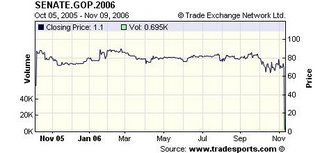 Since such markets are supposed to reflect the "wisdom of crowds", it might be a good time to reflect that markets still aren't crystal balls.
What are my predictions? I'm glad you asked!
First, both major political parties in the United States tend to draw their leaders from their most senior members. Most of these members got to be senior by coming from very "safe" states or Congressional districts. And safe states and districts, in practice, tend to be very strongly liberal or conservative -- in other words, statistical outliers in a country that for the past several elections has been evenly divided between Republicans and Democrats.
Political party leaders are not stupid. Well, some of them aren't. Still, by temperament and necessity they reflect the voters who elected them. This means that the voters who elected the Democratic Party leaders probably are not very similar to the voters who this past Tuesday brought the Democratic Party to power in Congress. This means the Democrats now face the very real threat the Republicans faced in 1994; that the less moderate faction of the party will set Congress' agenda for the next two years, against the wishes of the majority of "swing" voters who just put the party in power. The litmus test to see whether this is happening will be the reactions of those Democrats seriously vying to be President in 2008 -- Hillary Clinton, Barack Obama, John Edwards, and a few others. Most of these potential candidates have not been in office as long or come from as safe seats as Nancy Pelosi, David Obey, Barney Frank, or Charlie Rangel. If we see these presidential contenders begin rebelling, it will be a sure sign that the new Democratic Congress is heading in an unpopular direction.
* While Jeffords in Vermont was nominally an Independent, he caucused with the Democrats.
Senate seats aren't able to be gerrymandered, of course. Nonetheless, incumbents historically win 90 percent of Senate races. Since only 33 out of 100 Senate seats were up for election this week and the Democrats needed to win 6 of those to take control, the historical odds were not good. Even if the Democrats took all the Senate seats with no incumbents (Maryland, Minnesota, Tennessee, and Vermont), that would have given them one additional seat (Tennessee, which in fact has remained Republican).* Under a "normal" election cycle, we could then expect the 90 percent incumbent victory trend to mean the Democrats would have picked up 1.4 seats from the 14 Republican incumbents facing reelection, while losing 1.5 seats to the Republican. In other words, even if Senators are rarely, if ever, actually physically partitioned, we would still expect Democratic gains to be offset by nearly identical losses.
Instead, six incumbent Republican senators lost their reelection bids -- a 57 percent reelection ratio, versus the 100 percent reelection ratio for the 15 Democrats facing reelection. While those in the financial industry are fond of saying "past performance is no guarantee of future performance," this is still amazing. So amazing that the "futures" market Tradesports had been giving odds in the 70 to 80 percent range throughout October that the Republicans would maintain control of the Senate.
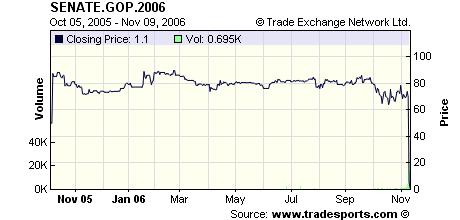 Since such markets are supposed to reflect the "wisdom of crowds", it might be a good time to reflect that markets still aren't crystal balls.
What are my predictions? I'm glad you asked!
First, both major political parties in the United States tend to draw their leaders from their most senior members. Most of these members got to be senior by coming from very "safe" states or Congressional districts. And safe states and districts, in practice, tend to be very strongly liberal or conservative -- in other words, statistical outliers in a country that for the past several elections has been evenly divided between Republicans and Democrats.
Political party leaders are not stupid. Well, some of them aren't. Still, by temperament and necessity they reflect the voters who elected them. This means that the voters who elected the Democratic Party leaders probably are not very similar to the voters who this past Tuesday brought the Democratic Party to power in Congress. This means the Democrats now face the very real threat the Republicans faced in 1994; that the less moderate faction of the party will set Congress' agenda for the next two years, against the wishes of the majority of "swing" voters who just put the party in power. The litmus test to see whether this is happening will be the reactions of those Democrats seriously vying to be President in 2008 -- Hillary Clinton, Barack Obama, John Edwards, and a few others. Most of these potential candidates have not been in office as long or come from as safe seats as Nancy Pelosi, David Obey, Barney Frank, or Charlie Rangel. If we see these presidential contenders begin rebelling, it will be a sure sign that the new Democratic Congress is heading in an unpopular direction.
* While Jeffords in Vermont was nominally an Independent, he caucused with the Democrats.
Thursday, November 09, 2006
NYSE's Thain on competing for global capital: Why does everyone get this wrong?
The New York Stock Exchange's chairman John Thain spoke before the first annual conference of the Securities Industry and Financial Markets Association (SIFMA) in Boca Raton, Florida this week. (This is the first conference for the SIFMA because it only came into existance this year, as a merger of the Securities Industry Association and the Bond Markets Association.)
Jeremy Grant of the Financial Times writes about Thain's speech here. Unfortunately, neither the NYSE or the SIFMA have yet to publish Thain's remarks, so I'm not sure what he actually said (since I didn't attend the conference). But Grant's description of this speech, which includes the now-expected language about how Sarbanes-Oxley, state regulators, and class action lawsuits are pushing foreign companies away from U.S. capital markets, includes this:
Most people, regardless of what they might think about this whole capital markets competitiveness debate (see here, here, here and here, if you want more), might just pass this off as typical speechifying. But it actually makes the same mistake that Stephen Bainbridge made a few weeks ago and which I wrote about here. That is, competing for public offerings and securities listings and competing for capital are not the same thing! Competing for capital means you are competing to attract investors -- i.e., the suppliers of capital. Competing for listings means you are competing to attract companies -- the users of capital. Of course, over the long-term, if you are good at attracting capital you will attract companies wanting to list on your market. But over the short- and medium-term, it's not at all clear that laws and regulations companies find onerous has any effect on your ability to attract capital (that is, investors). Indeed, you can easily imagine a situation where such laws actually attract investors, who become more confident in the integrity of your market. (Capital gains taxes, on the other hand, might actually hurt your ability to attract global capital.)
Why are these concepts so easily confused?
Jeremy Grant of the Financial Times writes about Thain's speech here. Unfortunately, neither the NYSE or the SIFMA have yet to publish Thain's remarks, so I'm not sure what he actually said (since I didn't attend the conference). But Grant's description of this speech, which includes the now-expected language about how Sarbanes-Oxley, state regulators, and class action lawsuits are pushing foreign companies away from U.S. capital markets, includes this:
[H]e said that the proliferation of lawsuits, Sarbanes-Oxley and overlapping regulations could stifle the country’s ability to compete for global capital. In a thinly veiled reference to London’s success in attracting company listings, Mr Thain acknowledged that US competitiveness was also threatened by exchanges around the world.
Most people, regardless of what they might think about this whole capital markets competitiveness debate (see here, here, here and here, if you want more), might just pass this off as typical speechifying. But it actually makes the same mistake that Stephen Bainbridge made a few weeks ago and which I wrote about here. That is, competing for public offerings and securities listings and competing for capital are not the same thing! Competing for capital means you are competing to attract investors -- i.e., the suppliers of capital. Competing for listings means you are competing to attract companies -- the users of capital. Of course, over the long-term, if you are good at attracting capital you will attract companies wanting to list on your market. But over the short- and medium-term, it's not at all clear that laws and regulations companies find onerous has any effect on your ability to attract capital (that is, investors). Indeed, you can easily imagine a situation where such laws actually attract investors, who become more confident in the integrity of your market. (Capital gains taxes, on the other hand, might actually hurt your ability to attract global capital.)
Why are these concepts so easily confused?
Big Audit Firms Release (Self) ''Serving Global Capital Markets and the Global Economy" Report
 The CEOs of the Big Four accounting and auditing firms (PricewaterhouseCoopers, KPMG, Deloitte & Touche and Ernst & Young) and two smaller firms (Grant Thornton and BDO International) yesterday issued a report titled, "Serving Global Capital Markets and the Global Economy" (see link here.) The past few years have been simultaneously tough and extremely profitable for these firms, and this report represents a response to the industry's critics. Following age-old advice, these firms apparently believe the best defense is a good offense.
The bad part of the past few years has been obvious: Enron, WorldCom, Parmalat, Shell Oil and a host of other companies were all caught in accounting scandals. In each case, the independent auditors charged with confirming that public companies weren't cooking the books were all found asleep at the post--or worse. Arthur Andersen ceased to exist after the U.S. government brought criminal charges against it for destroying evidence related to the Enron scandal. Italian prosecutors indicted the local branches of both Grant Thornton and Deloitte & Touche as a result of the Parmalat fraud. And, in the United States, the Sarbanes-Oxley Act created a new regulator (the Public Company Accounting Oversight Board) to end the industry's self-regulation.
On the plus side, however, with this new oversight has come record profits. Auditing used to be a loss-leader accounting firms used as a foot-in-the-door to sell big companies much more lucrative management and IT consulting projects. Now, with passage of the Sarbanes-Oxley Act and the new focus on internal controls, auditing has suddenly become very profitable. Particularly since, with Arthur Andersen gone, there's one few firm to compete with.
It is the cost of these auditor fees that is now driving the PCAOB to revise U.S. audit standards. (See here.) Nonetheless, the audit industry is feeling unloved, and "Serving Global Capital Markets" is an attempt to influence the public debate on how U.S. securities regulation might best be reformed. (In this regard, the six auditors join a bandwagon that includes the "Paulson Committee" and the U.S. Chamber of Commerce.)
The report begins, as one might expect, by admitting to, and then downplaying, past failures. "In the late 1990s and earlier this decade, however, in a small, but highly publicized number of cases in the United States, Europe and Japan, certain members of our profession failed to meet the standards of quality that govern our profession." Yes, mistakes were made. But we're all past that now. The report goes on to note how important the audit industry is to the world economy, and how over-regulation of it and its clients might kill the goose that lays the golden eggs.
The report then makes several recommendations, four of which stand out:
- The world's accounting and auditing standards need to be harmonized and based on principles rather than rules; and audit industry regulation should be coordinated at the international level (rather than, as is currently the case, effectively dictated at the international level by the PCAOB);
- Securities regulations should change so that issuers no longer need to report quarterly financial statements (i.e., 10-Qs and 10-Ks in the United States), but instead should report financial and non-financial information to the public on a "real-time" basis, over the Internet;
- Laws governing the audit industry should change so that accounting firms are no longer prohibited from offering consulting and tax advice to their audit clients "in light of the capital markets’ clear interest in assuring the continued attractiveness of the profession and its ability to bring in and retain individuals with the requisite talent and skills"; and,
- Auditor liability should be capped in shareholder lawsuits so that audit firms don't go under should they make another Enron-esqe mistake. ("Audit firms and their global networks are not insurance companies. Legal and regulatory systems must reflect this reality. Individual auditors who engage in wrongdoing must be punished but without threatening the financial viability of their firms.")
But more significantly, the report attempts to link the success of the U.S. GAAP-IFRS convergence project with the far more difficult effort to harmonized global auditing standards. Currently, International Standards on Auditing (ISAs) are a pale shadow of U.S. Generally Accepted Audit Standards (U.S. GAAS), and convergence is a long way off. (At the time of the Parmalat scandal, ISAs did not even require audit firms to confirm that a company's reported inventory existed. In other words, I could tell you that I have a warehouse in Hoboken with $3 million worth of product waiting to be sold, and you would not be remiss in your duties as an auditor if you just took my word for it.) For this reason, pushing for global harmonization of auditing standards -- and global "coordination" of auditor oversight -- could easily be seen as an attempt to weaken the iron grip of the PCAOB.
The second proposal is very interesting. But it is also pretty much a rehash of a proposal put forward by former SEC Chairman Harvey Pitt in 2001. Real-time disclosure of material information to investors would be a great boon, provided the quality and volume of information made available to the market increases, rather than decreases. At the same time, one can easily see how a real-time disclosure regime (particularly one enforced by a strong securities regulator) would be a God-send for accounting and law firms, which would pretty much have to become permanent fixtures in their clients' offices to ensure that the proper information was being disclosed. (The Financial Times has several articles on this proposal, here, here, and here. And given the way Barney Jopson writes, you might think the auditors' report is heralding the Second Coming.)
The third proposal, of course, is a desire to undo the conflicts of interest prohibitions contained in the Sarbanes-Oxley Act so that accounting firms can return to selling their audit clients very profitable management consulting work. However, it was the threat that they might lose such work that led to many of the financial scandals of the late 1990s through Enron and WorldCom. When a client holds out the promise of a multi-million dollar corporate restructuring consulting job, one can see how the pressure would mount on the audit partner to not upset the client with a harsh assessment of how it has accounted for its offshore "special purpose entities". Likewise, if an accounting firm has advised a client on how it should structure a corporate tax shelter, it's hard to imagine that same firm's auditors concluding that its colleagues over in the tax division screwed things up. The idea that accounting firms must be able to offer multiple services to the same client in order to attract bright young MBA and CPA employees properly deserves all the derision I can send its way.
And, finally, the issue of auditor liability is real, even if self-serving. (The New York Times' far more sceptical Floyd Norris writes about that aspect of the report here.) One problem world capital markets face today is that there are only four major international accounting firms left who are capable of offering a major multinational corporation a full multiple-country audit. (It is interesting that the heads of the Big Four pulled in the CEOs from Grant Thornton and BDO International for this report, since concentration in the audit industry is currently a topic of considerable discussion among securities regulators in North America, Europe and Asia. Representing the industry as a "Biggish Six" rather than a "Big Four" might be an attempt to stifle critics who argue audit industry concentration presents a risk to international financial stability and that governments should undertake to promote new rivals.) Consequently, in both the recent ChuoAoyama/PwC scandal in Japan and the KPMG tax evasion case in the United States, concerns were raised that a criminal indictment of either firm might pose a risk to the global financial system itself.
That said, "Serving Global Capital Markets" cannot help but be read as the audit industry's new campaign to limit its liability for future mistakes. The report cites an "expectation gap" regarding what they can do at a reasonable price, and what investors expect of them when it comes to detecting corporate fraud.
"...[T]he “expectations gap” arises because many investors, policy makers and the media believe that the auditor’s main function is to detect all fraud, and thus, where it materializes and auditors have failed to find it, the auditors are often presumed to be at fault. Given the inherent limitations of any outside party to discover the presence of fraud, the restrictions governing the methods auditors are allowed to use, and the cost constraints of the audit itself, this presumption is not aligned with the current auditing standards."
The problem with this view, of course, is that Enron, Parmalat and other corporate fraud cases were not simply matters of an auditor failing to detect an elaborate con perpetrated by evil masterminds. In the Parmalat case, it involved an auditor taking at face value an obviously forged letter purportedly from Citigroup attesting to the existance of an $800 million bank account. (The woman whose signature was forged actually did work for Citi, but apparently as a corporate librarian.) And, of course, while the report focuses on criminal penalties ("It is essential, going forward, for enforcement authorities to focus penalties for any auditor wrongdoing or negligence they may uncover on those directly implicated in such activities, rather than on the entire firms that employ them or with which they may be affiliated"), it is civil liability that is the crux of the matter. While auditors are not insurers against fraud, to argue that they cannot be held accountable for negligently overlooking fraud at the companies they audit is to suggest that their sole role is to check companies' financial statements for typos and math errors. Given that other participants in the global financial market (lawyers, investment banks, brokers, etc.) also face liability for negligence in the performance of their duties, why should auditors be different?
Tuesday, November 07, 2006
What’s wrong with the “NY-Lon debate”
I’ve been too grumpy to write recently because of a case of bubonic plague (or a nasty cold — can’t quite figure out which at the moment). However, an op-ed in the Financial Times today (“The NY-Lon Debate”) forced me away from my hot toddy long enough to get even more grumpy.
The FT notes a recent Wall Street Journal op-ed by New York City Mayor Michael Bloomberg (a Republican) and New York Senator Charles Schumer (a Democrat) (“To Save New York, Learn From London”). This op-ed demands changes to the Sarbanes-Oxley Act, U.S. shareholder litigation rights, and U.S. accounting standards (where did that come from??) in order to allow New York to fight back against the London onslaught on our financial markets.
Bloomberg’s opinion makes sense. To call Bloomberg “anti-regulation,” of course, would be a joke, given his nanny-state ideas about banning smoking, trans-fats and pretty much everything else he thinks is bad for you. But, as a former businessman and financier, you might expect him to be sensitive to anything that might impact the U.S. financial industry, if not the U.S. financial market (which isn’t at all the same thing).
For Schumer, on the other hand, the irony is just overwhelming. After all, Schumer was one of the foremost advocates of the strong version of the Sarbanes-Oxley Act, even adding his own provision banning corporations from making loans to their own executives. During SEC Chairman Christopher Cox's Senate confirmation hearings, Schumer also asked for (and received) assurances that Cox would not “roll-back” SOX. Best of all, of course, is that Schumer’s concerns about excessive regulation and litigation for some reason don't seem to include New York Attorney General Eliot Spitzer. Gee, I wonder why that is?
(The answer is because Schumer is an opportunistic hypocrite. Yeah, I know — big surprise.)
But back to the Financial Times op-ed. My favorite parts says:
Yet for London, “international” apparently means what we in the U.S. call “foreign.” So what about these foreign companies? While over the past year or so more non-British issuers have listed on the London Stock Exchange than non-U.S. issuers have listed in New York, foreign listings on the New York Stock Exchange still exceed those on the LSE. The difference, of course, is proportion — foreign listings are a relatively small proportion of total NYSE companies, while they make up a much larger proportion of the LSE.
And that gets me to my second question: why are foreign listings so important anyway? I’m not quite sure I’ve seen an answer to that, in either the Bloomberg/Schumer article or the FT op-ed. As the Financial Times notes, part of New York’s strength is that it can “draw on companies and investors from the world’s largest economy.” But isn’t that actually all of New York’s strength? Particularly the investors part? Right now, London is a world marketplace. And, as such, the City of London makes a profit off of the transactions that take place on that market. But the London Stock Exchange increasingly is a market for foreigners. It is not necessarily where British citizens put their money. The proportion of UK households invested in the UK capital market is approximately half the proportion of U.S. households invested in the U.S. capital market. For the U.S., then, a capital market is not just a place where financial firms turn a buck (or a pound) as middlemen, but a place where U.S. companies go to get low-cost capital and — more importantly — where U.S. investors go to get a high return on their dollars.
This point is underscored by several recent articles on the LSE’s Alternative Investment Market (AIM). An FT article last week by Sarah Spikes (“Evolution's profit warning highlights problem of dependency on Aim market”) notes that the poor performance of companies listing on the LSE’s low-cost/low-regulation exchange have put a serious dent in the profits of several investment banks. Indeed, over the past six months, as both the NYSE and NASDAQ have grown, shares listed on AIM have lost 20 percent. At the same time, many small and medium-sized UK enterprises are finding it far more costly to raise capital on the AIM than they expected. (See “Over-optimism causing UK mid-market failures”). Spikes’ first article quotes Andy Brough, a fund manager who specializes in small and mid-cap UK stocks for the UK investment firm Schroders as saying, “Surely the point of AIM should be to make money for investors, not just to make money for the stockbrokers that list companies on AIM.”
Indeed. Which brings up my final question. If the goal of a well-run capital market is to make money for investors and provide cheap capital to hungry companies, should it really be U.S. regulators’ concern if London now has a “critical mass” in certain areas — for example, Russian share issues? Given the corporate governance problems now plaguing Russian companies (see the Guardian’s Terry Macalister, “The Russians are coming — and bringing the threat of scandal to the City”), bragging about how your exchange is attracting the lion’s share of these questionable listings is a bit like a West Virginia trailer park bragging about how it is beating the pants off Martha’s Vineyard in the fast-growing mobile home market. It may be true, and it may be true that trailer park developers in West Virginia are making a ton of cash, while real estate developers in ritzier neighborhoods are getting hosed. But is it really the job of financial regulators to protect the profits of the “real estate developers” of the financial markets (i.e., the exchanges and market intermediaries)? Shouldn't the focus rather be on investors and issuers — no matter how many multi-billion dollar Rosneft or ICBC IPOs the market intermediaries lose out on?
The FT notes a recent Wall Street Journal op-ed by New York City Mayor Michael Bloomberg (a Republican) and New York Senator Charles Schumer (a Democrat) (“To Save New York, Learn From London”). This op-ed demands changes to the Sarbanes-Oxley Act, U.S. shareholder litigation rights, and U.S. accounting standards (where did that come from??) in order to allow New York to fight back against the London onslaught on our financial markets.
Bloomberg’s opinion makes sense. To call Bloomberg “anti-regulation,” of course, would be a joke, given his nanny-state ideas about banning smoking, trans-fats and pretty much everything else he thinks is bad for you. But, as a former businessman and financier, you might expect him to be sensitive to anything that might impact the U.S. financial industry, if not the U.S. financial market (which isn’t at all the same thing).
For Schumer, on the other hand, the irony is just overwhelming. After all, Schumer was one of the foremost advocates of the strong version of the Sarbanes-Oxley Act, even adding his own provision banning corporations from making loans to their own executives. During SEC Chairman Christopher Cox's Senate confirmation hearings, Schumer also asked for (and received) assurances that Cox would not “roll-back” SOX. Best of all, of course, is that Schumer’s concerns about excessive regulation and litigation for some reason don't seem to include New York Attorney General Eliot Spitzer. Gee, I wonder why that is?
(The answer is because Schumer is an opportunistic hypocrite. Yeah, I know — big surprise.)
But back to the Financial Times op-ed. My favorite parts says:
...New York has now fallen behind London in raising capital for international companies. New York needs to overhaul its markets and its regulation but its verve as a city, its depth of human experience and its access to US capital mean that a fightback is guaranteed.My first question, as usual, is, what are these “international companies” we keep hearing about? For me, at least, an “international company” is a company with international operations. And if you are looking at that, New York is still by far the largest market for international companies. It’s just that most of the companies with international operations trading in New York happen to be headquartered in the United States. Notwithstanding the pain of Sarbanes-Oxley, no major U.S. public company has made London its primary listing.
The question for New York is whether the damage is permanent. A 1963 tax law, which made it unattractive for foreign entities to borrow in New York, suggests that it may be. The 1963 law created London's Eurobond market but, on repeal in 1974, bond issuance stayed in Europe. Even if Sarbox disappeared tomorrow, New York might not win back business - such as Russian share issues - where London now has critical mass.
New York, though, should never be underestimated as a financial centre or as a city. It has great strengths. It is home to most of the world's top investment banks. It has the world's most efficient clearing and settlement infrastructure. And it can draw on the companies and investors of the world's largest economy.
Yet for London, “international” apparently means what we in the U.S. call “foreign.” So what about these foreign companies? While over the past year or so more non-British issuers have listed on the London Stock Exchange than non-U.S. issuers have listed in New York, foreign listings on the New York Stock Exchange still exceed those on the LSE. The difference, of course, is proportion — foreign listings are a relatively small proportion of total NYSE companies, while they make up a much larger proportion of the LSE.
And that gets me to my second question: why are foreign listings so important anyway? I’m not quite sure I’ve seen an answer to that, in either the Bloomberg/Schumer article or the FT op-ed. As the Financial Times notes, part of New York’s strength is that it can “draw on companies and investors from the world’s largest economy.” But isn’t that actually all of New York’s strength? Particularly the investors part? Right now, London is a world marketplace. And, as such, the City of London makes a profit off of the transactions that take place on that market. But the London Stock Exchange increasingly is a market for foreigners. It is not necessarily where British citizens put their money. The proportion of UK households invested in the UK capital market is approximately half the proportion of U.S. households invested in the U.S. capital market. For the U.S., then, a capital market is not just a place where financial firms turn a buck (or a pound) as middlemen, but a place where U.S. companies go to get low-cost capital and — more importantly — where U.S. investors go to get a high return on their dollars.
This point is underscored by several recent articles on the LSE’s Alternative Investment Market (AIM). An FT article last week by Sarah Spikes (“Evolution's profit warning highlights problem of dependency on Aim market”) notes that the poor performance of companies listing on the LSE’s low-cost/low-regulation exchange have put a serious dent in the profits of several investment banks. Indeed, over the past six months, as both the NYSE and NASDAQ have grown, shares listed on AIM have lost 20 percent. At the same time, many small and medium-sized UK enterprises are finding it far more costly to raise capital on the AIM than they expected. (See “Over-optimism causing UK mid-market failures”). Spikes’ first article quotes Andy Brough, a fund manager who specializes in small and mid-cap UK stocks for the UK investment firm Schroders as saying, “Surely the point of AIM should be to make money for investors, not just to make money for the stockbrokers that list companies on AIM.”
Indeed. Which brings up my final question. If the goal of a well-run capital market is to make money for investors and provide cheap capital to hungry companies, should it really be U.S. regulators’ concern if London now has a “critical mass” in certain areas — for example, Russian share issues? Given the corporate governance problems now plaguing Russian companies (see the Guardian’s Terry Macalister, “The Russians are coming — and bringing the threat of scandal to the City”), bragging about how your exchange is attracting the lion’s share of these questionable listings is a bit like a West Virginia trailer park bragging about how it is beating the pants off Martha’s Vineyard in the fast-growing mobile home market. It may be true, and it may be true that trailer park developers in West Virginia are making a ton of cash, while real estate developers in ritzier neighborhoods are getting hosed. But is it really the job of financial regulators to protect the profits of the “real estate developers” of the financial markets (i.e., the exchanges and market intermediaries)? Shouldn't the focus rather be on investors and issuers — no matter how many multi-billion dollar Rosneft or ICBC IPOs the market intermediaries lose out on?
Wednesday, November 01, 2006
John Kerry: Just shut up
 I'm not a Don Imus fan, but he's right: John Kerry just needs to shut up. As I've said before, Kerry is still an idiot, and his comments to college students that if they don't study, they'll end up in Iraq just confirms it. Why the Democrats ever thought he was a suitable alternative to Bush still boggles my mind. What's amusing, though, is now many Democratics seems to be having those same thoughts. (See here.) What's also amusing is that the lesson Kerry seems to have drawn from the "Swift Boat Veterans" in 2004 is that any attack calls for an immediate and violent counterattack. I think this shows Kerry has a learning curve, in the sense that that is what he should have done (but didn't) in 2004. However, that this incident is a completely different kind of problem for him shows that the learning curve isn't too steep. Rapid nasty counterattacks are great if your opponent has made ridiculous and false accusations about you and you want to stop them from gaining traction; but if you are the one who stepped in the dog poop, they won't do.
In this sense, I think Kerry offers a good lesson for Democrats in what (not) to look for in 2008 presidential candidates. The first and most important lesson is to pick a candidate who actually won an election in a state with a large number of Republican voters. Massachusetts is not such a state. Fidel Castro, from his hospital bed, could run as a Democrat in Massachusetts and, if he were the only Democrat on the ballot, he would win. Bill Clinton, by contrast, came from a state (Arkansas) that goes either way. This has several advantages: first, it means the candidate knows how to appeal to a broader base and has the political skills to keep it from looking like obvious pandering. But perhaps more importantly, it means the candidate has enough touch with the broader electorate that that person automatically sees a red flag before saying something really stupid. If you are only used to Massachusetts voters, I can easily see how you might think Kerry's "botched" joke was funny. And, indeed, tell that joke to a bunch of Amherst students, and you'd probably get a lot of laughs. But you just come off looking like an idiot to the rest of the country.
Interestingly, what does this mean for Barack Obama? After all, he does come from a state with a sizable number of Republican voters. That said, he only won after his Republican rival self-destructed in a divorce scandal involving a beautiful cyborg ex-wife, and was replaced by an insane carpetbagger from Maryland. Does Obama have what it takes to take on a real opponent? Right now, nobody knows.
On the other hand, will Kerry's comments have an effect on the Republicans' chances of retaining the House next Tuesday? I kinda doubt it. Bush is still the face of the Republican Party, but Kerry is no longer the public face of the Democrats.
Tuesday, October 31, 2006
C'est le CNN contradictoire
 The Agence Française de Presse is reporting that the international French news channel France 24 will start broadcasting worldwide in both English and French in an attempt to offer a "contradictory" view to those offered by the "Anglo-Saxon" CNN and the BBC. ("French news channel to challenge 'Anglo-Saxon' CNN, BBC").
I love it when the French lump us and the Brits together as "Anglo-Saxons". It makes me want to grab my horned helmet and defend the great hall from Grendel the troll.
However, if anyone out there is qualified to offer contradictory opinions, it is the French. It just has to hurt that they feel forced to do this with an English broadcast.
Monday, October 30, 2006
Shareholder democracy in the U.S. brought to task
An interesting article by Kate Burgess and Andrew Grant in this past week's Financial Times ("Investors 'lack basic rights' on US boards") notes a peculiar feature of U.S. corporate governance and securities law. In particular, while the United States has been at the bleeding edge of securities law reform designed to strengthen corporate disclosure standards and come down hard on managerial malfeasance, the actual rights of shareholders of U.S. companies to "kick the bums out" (i.e., replace not just crooked but also poorly performing managers and board members) is surprisingly weak. This is even more so when the U.S. is compared with other Common Law countries such as the United Kingdom and Australia.
As Adolf Berle and Gardinar Means noted 70 years ago, the modern corporation is characterized by a "separation of ownership and control" -- in other words, the people who own the company (shareholders) do not actually run it. This is in stark contrast to most other models for organizing human economic behavior, such as partnerships, where the entrepreneurs who put in their money to create the organization actually have a close hand in running it (and face a significant personal risk should it fail). In fact, this single feature of the modern corporation is both its greatest strength and most dangerous weakness. The strength comes from the fact that modern corporations can draw on financing from millions of investors willing to accept a (comparatively) small risk for a small return, rather than the handful willing to take a major risk for a big potential return. But the weakness is that corporate managers are using "other people's money" when they run the company, and this poses an inherent conflict of interest.
This strength and weakness was recognized as long ago as 1776, when Adam Smith wrote in The Wealth of Nations:
This issue recently became more prominent in the United States when the Second Circuit Court of Appeals ruled last year in AFSCME Pension Plan v. AIG, Inc. that the SEC's rule on proxy voting is unclear. When that decision came out, the SEC agreed to clarify the rule to state whether companies must include in proxy materials proposals to modify how board members are elected. However, the SEC recently backed off on when it will conduct this clarification, as apparently there is no consensus among the five Commissioners about how to do this.
This is a shame, as a recent letter to SEC Chairman Christopher Cox from 16 U.S. and international investors points out. As a large number of these investors are foreign (including the Association of British Insurers and the Third Swedish National Pensions Fund), they note in the letter that:
As a practical matter, the institutional investors' letter may tie in closely to efforts underway by the so-called "Paulson Committee" (see here), though it seems likely that Hal Scott, Glenn Hubbard and John Thornton might not see it that way. Restraining tort lawyers may go a long way to improving the competitiveness of U.S. capital markets. However, such restraint will not be likely (or helpful) if other mechanisms for disciplining corporate boards and managers are not available. Therefore, improving shareholder proxy voting processes so shareholders are given back the right to appoint their own boards of directors, is important. It will make corporate managers more accountable for long-term performance, and better align the interests of those who control modern companies with those who own them.
As Adolf Berle and Gardinar Means noted 70 years ago, the modern corporation is characterized by a "separation of ownership and control" -- in other words, the people who own the company (shareholders) do not actually run it. This is in stark contrast to most other models for organizing human economic behavior, such as partnerships, where the entrepreneurs who put in their money to create the organization actually have a close hand in running it (and face a significant personal risk should it fail). In fact, this single feature of the modern corporation is both its greatest strength and most dangerous weakness. The strength comes from the fact that modern corporations can draw on financing from millions of investors willing to accept a (comparatively) small risk for a small return, rather than the handful willing to take a major risk for a big potential return. But the weakness is that corporate managers are using "other people's money" when they run the company, and this poses an inherent conflict of interest.
This strength and weakness was recognized as long ago as 1776, when Adam Smith wrote in The Wealth of Nations:
This total exemption from trouble and from risk, beyond a limited sum, encourages many people to become adventurers in joint stock companies, who would, upon no account, hazard their fortunes in any copartnery. Such companies, therefore, commonly draw to themselves much greater stocks than any private copartnery can boast of. ...The directors of such companies, however, being the managers rather of other people's money than of their own, it cannot well be expected, that they should watch over it with the same anxioux vigilance with which the partners in a private copartnery frequently watch over their own. Like the stewards of a rich man, they are apt to consider attention to small matters as not for their master's honour, and very easily give themselves a dispensation from having it. Negligence and profusion therefore, must always prevail, more or less, in the management of the affairs of such a company.Corporate governance and securities laws are two tools designed to reduce this problem. Corporate governance laws are meant to provide shareholders with mechanisms by which their own interests are protected against management, while securities laws are designed to give them accurate information about how the company is performing so they can make informed decisions. In the United States, corporate governance is mostly a function of state law and, in practice, of Delaware law in particular. And Delaware didn't become the home jurisdiction of 70 percent of U.S. public companies because of its particularly pro-shareholder approach. Quite the contrary. Delaware permits a number of anti-takeover devices, such as poison pills and staggered board member terms, designed to make it very difficult for shareholders to kick poorly performing managerial teams out of their coveted positions.
This issue recently became more prominent in the United States when the Second Circuit Court of Appeals ruled last year in AFSCME Pension Plan v. AIG, Inc. that the SEC's rule on proxy voting is unclear. When that decision came out, the SEC agreed to clarify the rule to state whether companies must include in proxy materials proposals to modify how board members are elected. However, the SEC recently backed off on when it will conduct this clarification, as apparently there is no consensus among the five Commissioners about how to do this.
This is a shame, as a recent letter to SEC Chairman Christopher Cox from 16 U.S. and international investors points out. As a large number of these investors are foreign (including the Association of British Insurers and the Third Swedish National Pensions Fund), they note in the letter that:
It cannot be emphasized enough how difficult it is for investors based outside the US to come to grips with the fact that shareholders of US companies lack basic rights which they take for granted in other developed markets. Both in principle and in practice, the American board election procedure is both outdated and detrimental to the maximization of long-term shareholder value.Normally I would say that this sounds like typical UK whining. ("It cannot be emphasized enough..."? I mean, who says that?? And anyone complaining about the lack of shareholder rights in the U.S. clearly hasn't seen the system in France or Japan.) That said, they do have a point. Under the current system, the only control investors have over board performance is by "voting with their feet" -- divesting themselves of companies with underperforming boards or management. However, for large pension funds or index-based mutual funds, such divestments may not be practical or even permitted. At the same time, given how difficult hostile takeovers are in the United States, "normal" market mechanisms that might act to discipline a corporate board just aren't there, and the only real mechanism for a shareholder to assert his or her rights is through shareholder derivative litigation -- a costly, often self-defeating process.
As a practical matter, the institutional investors' letter may tie in closely to efforts underway by the so-called "Paulson Committee" (see here), though it seems likely that Hal Scott, Glenn Hubbard and John Thornton might not see it that way. Restraining tort lawyers may go a long way to improving the competitiveness of U.S. capital markets. However, such restraint will not be likely (or helpful) if other mechanisms for disciplining corporate boards and managers are not available. Therefore, improving shareholder proxy voting processes so shareholders are given back the right to appoint their own boards of directors, is important. It will make corporate managers more accountable for long-term performance, and better align the interests of those who control modern companies with those who own them.
Sunday, October 29, 2006
Prospective chair of House Finance Committee raises questions about global financial regulation
On a recent trip abroad, I was asked several times about the likelihood that the Sarbanes-Oxley Act would be repealed in the coming year, given Treasury Secretary Hank Paulson's stated desire to streamline U.S. financial regulation. (See here and here.) This is an understandable question. After all, if most of your U.S. news comes from the Wall Street Journal and Financial Times and you don't have a thorough understanding of the U.S. political system, you could see how someone might come to think that it is a matter of time before SOX gets pulled. However, as I've noted before, the Treasury Department in the United States is not as powerful as the finance ministries of most countries. Further, if the Democrats take control of the House of Representatives on November 7 (which seems more likely than not at this point), chances of a repeal of Sarbanes-Oxley drop considerably. Chances drop even more if, as expected, the SEC and PCAOB radically restructure how SOX Section 404 is implemented (see here).
This view was repeated this week by Representative Barney Frank (D-Mass.), who is clearly trying out for size the chairman's seat of the House Finance Committee. (As the senior Democrat on the committee, Frank is in line to become chairman should the Democrats gain a majority in the House.) In an interview with the Financial Times ("Top Democrat casts doubt on regulatory co-operation"), Frank stated that European concerns about the possible "export" of Sarbanes-Oxley were overblown, because "it's not going to happen" and "[s]ix months from now it will be less of a burden for companies than it is today. ...They [the SEC and Public Company Accounting Oversight Board] have the authority to thin out what is required. We think the accountants probably overloaded on the audit requirements."
However, Frank also cast doubt on the value of international regulatory cooperation:
I'm not sure what to make of that statement, frankly. Frank certainly knows that the idea of a surpra-national financial regulator is a non-starter in the United States, unless, of course, the U.S. regulator were to be the international regulator. Even if the U.S. political environment changed so radically that international-level financial regulation were to become politically acceptable (and it certainly won't), current American laws make it illegal for U.S. securities and banking regulators to delegate any oversight or powers to an international organization. So, either Frank was talking without thinking (which wouldn't be the first time a politician has done that), or he was thinking of something else entirely. If he was thinking something else entirely, it is not at all clear what that might be.
This view was repeated this week by Representative Barney Frank (D-Mass.), who is clearly trying out for size the chairman's seat of the House Finance Committee. (As the senior Democrat on the committee, Frank is in line to become chairman should the Democrats gain a majority in the House.) In an interview with the Financial Times ("Top Democrat casts doubt on regulatory co-operation"), Frank stated that European concerns about the possible "export" of Sarbanes-Oxley were overblown, because "it's not going to happen" and "[s]ix months from now it will be less of a burden for companies than it is today. ...They [the SEC and Public Company Accounting Oversight Board] have the authority to thin out what is required. We think the accountants probably overloaded on the audit requirements."
However, Frank also cast doubt on the value of international regulatory cooperation:
"Joint action is theoretically [good] but what does that mean? In American baseball, if the runner and the ball arrive at the base at the same time, the tie goes to the fielder. Who breaks a tie if there is a disagreement over policy between the SEC and FSA?"Frank then stated that he wasn't sure if a supra-national regulator was a good idea, but it might be something useful to look at in the future.
I'm not sure what to make of that statement, frankly. Frank certainly knows that the idea of a surpra-national financial regulator is a non-starter in the United States, unless, of course, the U.S. regulator were to be the international regulator. Even if the U.S. political environment changed so radically that international-level financial regulation were to become politically acceptable (and it certainly won't), current American laws make it illegal for U.S. securities and banking regulators to delegate any oversight or powers to an international organization. So, either Frank was talking without thinking (which wouldn't be the first time a politician has done that), or he was thinking of something else entirely. If he was thinking something else entirely, it is not at all clear what that might be.
Thursday, October 26, 2006
Restaurant Smoking Bans Redux
In a previous post ("Restaurant Smoking Bans"), M.D. Fatwa argued that smoking bans probably make sense, because there's very clearly a negative externality and a market failure. MDF suggests that the political popularity of smoking bans is evidence of a market failure. This is, to say the least, a deeply problematic statement. A proposal that would take $20 away from one person, burn half of them, and then split the rest among ten other people might be extremely politically popular -- over 90%! -- but the market's failure to provide this "service" is an argument in favor of markets and against government. But let's set this aside: it's not his main point.
Nor should we really concern ourselves with why, if MDF is right, hypersensitive nonsmokers don't constitute sufficiently large demand to create a market for nonsmoking restaurants. After all, MDF is a country boy living in the midwest, which as any good eastern elite like myself knows, is a vast wilderness where there are dragons and only a very small number of tiny villages with very few people. 10% of the population wouldn't be large enough to create a market for non-smoking restaurants -- that's, like, 1 person. In Chicago, maybe 2 or 3 -- totally not enough to support a restaurant. So we have to cut him some slack here.
The real problem with MDF's model of market failure is that ... he's not proposing a model of market failure. Market failure is when there exist costs or benefits that are not borne by the decision makers AND this alignment leads to over- or underproduction. It's kind of odd that MDF imagines the first requirement is being met -- apparently positionally sensitive nonsmokers are imagined to go to restaurants just as often and be willing to pay just as high a price when there is some smoking as when there's not. (If they went less, restaurants would get less profits, in which case they're internalizing the costs of their decision, right?) But okay, fine: let's suppose they don't go less and so there are external costs. But these external costs aren't translating into decreased restaurant attendance or food consumption (again, this is a necessary consequence of the stipulation that the costs of smoking borne by nonsmokers don't affect the restaurants' bottom lines). So where's the market failure? The market is producing the correct amount of output -- all we're talking about is the division of the value of the output.
The only way out is to say that positionally sensitive nonsmokers make their restaurant-attending decisions premised on the assumption that they will definitely not be affected by smoking, but then they get to the restaurant, sit next to the smoke, and think, "Crap! I forgot that there's such a thing as a smoking section! I really need to write that down -- or maybe we should just pass a law, because I can't be expected to remember stuff like that." Which is to say, they're irrational (which I suppose one could believe: I'm just not sure why, given that one believes some nonsmokers are irrational, one would also believe that those same nonsmokers should be allowed to make decisions about what kind of restaurant they're going to eat at ... or, much more importantly, what kind of restaurant I am going to eat at).
But leaving aside the possibility of irrationality, the only possibilities are that nonsmokers never decide to stop going to restaurants because of smoking, or that they do, but that the decrease in restaurant attendance by nonsmokers is more than made up by the increase in smoker attendance because smoking is allowed. Either way, there's no market failure.
Okay, so if there's no market failure, why are smoking bans so politically popular? Well, as MDF pointed out, 80% of the population doesn't smoke. So if all smokers vote against smoking bans and all nonsmokers vote for bans, how does that work out? Again, this doesn't mean there's a market failure -- elections don't count intensity of preference. (In other words, a vote of 2 yes's and 1 "no, oh no, please God, no!" still goes to the "yes" people.) So what we might have here is a plain old-fashioned story of rent-seeking: smoking bans might have higher costs than benefits, but why would a non-smoker care so long as the costs were borne by other people?
This might run into problems if voting for smoking bans will make even nonsmokers worse off (which it might very well). But who said people vote in a narrowly self-interested fashion? Some people who haven't been to a bar in years vote on whether we should ban smoking in bars -- how on earth could either outcome matter to them enough to justify going down to the voting booth? Well, it might matter if they also care if you are smoking in bars. So how's that one likely to break -- are there more people who (a) think that smoking is bad and therefore you should be kept from smoking (or kept from working around smoke), or (b) who think that it's none of their business whether you smoke or work in a bar? If you think (b), you need to get out more.
Finally, this could just be a matter of expressive voting. Look: unless your name is "Sandra Day O'Connor" or "Anthony Kennedy," your vote doesn't count. You will not ever break a tie. But you're not stupid and you know this -- so why would you vote as if the election turns on your decision? The answer is you probably don't. There are people in Texas who voted for Nader in 2000. Did they think Texas might not go to Bush? Of course not -- a lot of them would have voted for Gore if they thought their vote mattered. Given that your vote doesn't matter, you might just vote the way that makes you feel good. So, what, you want to be the kind of person who votes for blowing smoke in children's face? What about proposition "Let's not kick puppies?"
So, fine, let's ban smoking. But please let's not pretend that there's a market failure or that there's some sort of greater public interest story here. Nonsmokers have a majority and they can do what they want, or think they want, or like to tell other people that they want. End of story.
Nor should we really concern ourselves with why, if MDF is right, hypersensitive nonsmokers don't constitute sufficiently large demand to create a market for nonsmoking restaurants. After all, MDF is a country boy living in the midwest, which as any good eastern elite like myself knows, is a vast wilderness where there are dragons and only a very small number of tiny villages with very few people. 10% of the population wouldn't be large enough to create a market for non-smoking restaurants -- that's, like, 1 person. In Chicago, maybe 2 or 3 -- totally not enough to support a restaurant. So we have to cut him some slack here.
The real problem with MDF's model of market failure is that ... he's not proposing a model of market failure. Market failure is when there exist costs or benefits that are not borne by the decision makers AND this alignment leads to over- or underproduction. It's kind of odd that MDF imagines the first requirement is being met -- apparently positionally sensitive nonsmokers are imagined to go to restaurants just as often and be willing to pay just as high a price when there is some smoking as when there's not. (If they went less, restaurants would get less profits, in which case they're internalizing the costs of their decision, right?) But okay, fine: let's suppose they don't go less and so there are external costs. But these external costs aren't translating into decreased restaurant attendance or food consumption (again, this is a necessary consequence of the stipulation that the costs of smoking borne by nonsmokers don't affect the restaurants' bottom lines). So where's the market failure? The market is producing the correct amount of output -- all we're talking about is the division of the value of the output.
The only way out is to say that positionally sensitive nonsmokers make their restaurant-attending decisions premised on the assumption that they will definitely not be affected by smoking, but then they get to the restaurant, sit next to the smoke, and think, "Crap! I forgot that there's such a thing as a smoking section! I really need to write that down -- or maybe we should just pass a law, because I can't be expected to remember stuff like that." Which is to say, they're irrational (which I suppose one could believe: I'm just not sure why, given that one believes some nonsmokers are irrational, one would also believe that those same nonsmokers should be allowed to make decisions about what kind of restaurant they're going to eat at ... or, much more importantly, what kind of restaurant I am going to eat at).
But leaving aside the possibility of irrationality, the only possibilities are that nonsmokers never decide to stop going to restaurants because of smoking, or that they do, but that the decrease in restaurant attendance by nonsmokers is more than made up by the increase in smoker attendance because smoking is allowed. Either way, there's no market failure.
Okay, so if there's no market failure, why are smoking bans so politically popular? Well, as MDF pointed out, 80% of the population doesn't smoke. So if all smokers vote against smoking bans and all nonsmokers vote for bans, how does that work out? Again, this doesn't mean there's a market failure -- elections don't count intensity of preference. (In other words, a vote of 2 yes's and 1 "no, oh no, please God, no!" still goes to the "yes" people.) So what we might have here is a plain old-fashioned story of rent-seeking: smoking bans might have higher costs than benefits, but why would a non-smoker care so long as the costs were borne by other people?
This might run into problems if voting for smoking bans will make even nonsmokers worse off (which it might very well). But who said people vote in a narrowly self-interested fashion? Some people who haven't been to a bar in years vote on whether we should ban smoking in bars -- how on earth could either outcome matter to them enough to justify going down to the voting booth? Well, it might matter if they also care if you are smoking in bars. So how's that one likely to break -- are there more people who (a) think that smoking is bad and therefore you should be kept from smoking (or kept from working around smoke), or (b) who think that it's none of their business whether you smoke or work in a bar? If you think (b), you need to get out more.
Finally, this could just be a matter of expressive voting. Look: unless your name is "Sandra Day O'Connor" or "Anthony Kennedy," your vote doesn't count. You will not ever break a tie. But you're not stupid and you know this -- so why would you vote as if the election turns on your decision? The answer is you probably don't. There are people in Texas who voted for Nader in 2000. Did they think Texas might not go to Bush? Of course not -- a lot of them would have voted for Gore if they thought their vote mattered. Given that your vote doesn't matter, you might just vote the way that makes you feel good. So, what, you want to be the kind of person who votes for blowing smoke in children's face? What about proposition "Let's not kick puppies?"
So, fine, let's ban smoking. But please let's not pretend that there's a market failure or that there's some sort of greater public interest story here. Nonsmokers have a majority and they can do what they want, or think they want, or like to tell other people that they want. End of story.
Subscribe to:
Posts (Atom)
